 뒤로
Chapter 5: The Structure and Function of Large Biological Molecules
 01:17

이 집합의 용어 (29)
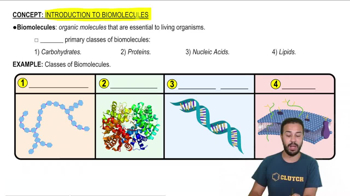
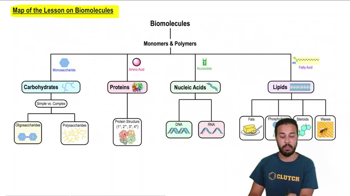
Macromolecules are large polymers built from smaller units called monomers. Examples include carbohydrates, proteins, and nucleic acids.
A dehydration reaction joins two monomers by removing a water molecule, forming a new covalent bond.
Hydrolysis is the reverse of dehydration; it breaks polymers into monomers by adding a water molecule.
Monosaccharides are simple sugars with molecular formulas usually multiples of CH2O, such as glucose (C6H12O6).
By the location of the carbonyl group (aldose or ketose) and the number of carbons in the skeleton (triose, pentose, hexose).
A glycosidic linkage is a covalent bond formed between two monosaccharides during a dehydration reaction.
Polysaccharides are polymers of sugars with storage (e.g., starch, glycogen) and structural roles (e.g., cellulose, chitin).
Both are glucose polymers, but starch has α linkages (helical) and cellulose has β linkages (straight, unbranched), affecting digestibility.
Chitin is a structural polysaccharide found in arthropod exoskeletons and fungal cell walls, composed of modified glucose monomers.
Lipids are hydrophobic molecules not true polymers, mainly composed of hydrocarbon regions; include fats, phospholipids, and steroids.
Fats are made of glycerol and three fatty acids joined by ester linkages, forming triacylglycerols (triglycerides).
Saturated fatty acids have no double bonds and are solid at room temperature; unsaturated fatty acids have one or more double bonds and are liquid.
Hydrogenation converts unsaturated fats to saturated fats by adding hydrogen, sometimes creating harmful trans fats.
Fats primarily function in energy storage, cushioning organs, and insulating the body.
Phospholipids have two hydrophobic fatty acid tails and a hydrophilic phosphate head; they form bilayers that make up cell membranes.
Steroids have a carbon skeleton of four fused rings; cholesterol is a key steroid in animal membranes and precursor to other steroids.
Proteins are polymers of amino acids with diverse functions including catalysis, defense, transport, signaling, and structural support.
The primary structure is the unique linear sequence of amino acids in a polypeptide chain.
Primary (amino acid sequence), secondary (α helices and β sheets), tertiary (3D folding from side chain interactions), and quaternary (multiple polypeptides).
Changes in pH, salt concentration, temperature, or chemicals can cause proteins to lose their native structure and function.
Nucleic acids are polymers of nucleotides that store and transmit hereditary information; DNA and RNA are the two types.
A nucleotide consists of a nitrogenous base, a pentose sugar, and one or more phosphate groups.
Pyrimidines have a single six-membered ring (C, T, U); purines have fused six- and five-membered rings (A, G).
Nucleotides are linked by phosphodiester bonds forming a sugar-phosphate backbone with nitrogenous bases as appendages.
DNA is a double helix of two antiparallel polynucleotide strands with complementary base pairing: A with T, G with C.
RNA is usually single-stranded, uses ribose sugar, and has uracil (U) instead of thymine (T).
Gene expression is the process where DNA directs synthesis of mRNA, which then directs protein synthesis.
Genomics studies whole genomes; proteomics studies large sets of proteins and their functions.
Sequences of DNA and proteins serve as molecular records to trace hereditary relationships and evolutionary history.