 뒤로
Chapter 7 Con't oct 28th
 03:32

이 집합의 용어 (29)
Distance between crests of electromagnetic waves.
A discrete packet of light energy with fixed energy; shorter wavelengths have more energy and
(can damage proteins/nucleic acids) then longer wavelengths.
Light-absorbing molecules in thylakoid membranes that absorb some wavelengths of light and reflect others.
Absorbs blue-violet and red light; directly participates in light reactions of photosynthesis.
Absorbs blue and orange light; transfers energy to chlorophyll A.
Pigments reflecting yellow/orange; more stable than chlorophyll, pass energy to chlorophyll; broaden spectrum of colours for photosynthesis and provide photoprotection.
Process where carotenoids capture and dissipate excess light energy to prevent damage to chlorophyll and cells. (protection from excessive light energy.)
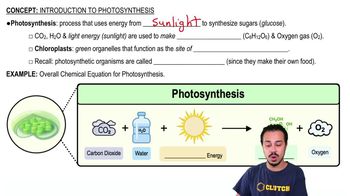
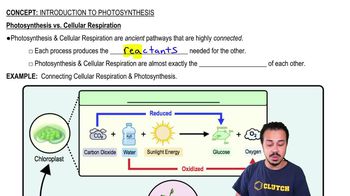
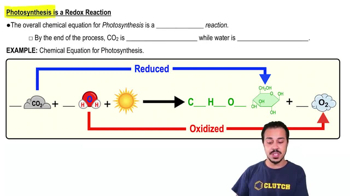
Electrons gain potential energy as they move from H2O to CO2, powered by sunlight; photosynthesis is the reverse of cellular respiration.
Light reactions in thylakoids capture light energy; Calvin cycle in stroma fixes carbon into sugars.
Stage 1: Light reactions?
Light energy absorbed by chlorophyll; H2O split releasing O2; electrons reduce NADP+ to NADPH; ATP produced by chemiosmosis.
Electron jumps to higher energy level when photon absorbed by pigment molecule, then returns to ground state releasing heat and sometimes fluorescence.
Pigment molecules bound to proteins that harvest light from different wavelengths and increase surface area for efficient light harvesting.
Pair of specialized chlorophyll molecules bound to proteins w/ a primary electron acceptor that captures excited electrons.
Two complexes (Photosystem II and I), each with reaction centre surrounded by light harvesting complexes; work sequentially in light reactions.
Photosystem II excites electrons first, passing them down ETC to make ATP; Photosystem I excites electrons second, producing NADPH; both linked by electron transport chain.
H2O split into 1 oxygen which joins with another to form O2 and 2 hydrogen ions = H+, and 2 electrons; electrons replace those lost by chlorophyll A; O2 released, H+ stays in thylakoid to build UP concentration.
Chemiosmosis PRODUCES ATP. H+ gradient drives ATP synthase to phosphorylate ADP into ATP during light reactions.
What happens in Stage 2: Calvin cycle?
CO2 from air fixed into organic molecules ad reduced using ATP & NADPH from light reactions to make G3P (glyceraldehyde-3-phosphase), which the cell will then use to make glucose, sucrose, & organic molecules.
CO2 attached to RuBP by rubisco enzyme, forming unstable 6-carbon molecule that splits into two 3-carbon molecules.
ATP and NADPH reduce 3-carbon molecules to glyceraldehyde-3-phosphate (G3P); NADPH provides electrons, ATP provides energy.
For every 3 CO2 fixed, 1 G3P molecule is released as product.
Five G3P molecules rearranged using ATP to regenerate three RuBP molecules.
Uses 9 ATP and 6 NADPH provided by light reactions.
When O2 builds up, rubisco (sloppy enzyme) adds O2 to RuBP instead of CO2, producing a 2-carbon product INSTEAD of G3P, using ATP and NADPH without sugar production.
C3 plants: Standard plants using CO2 from air and use Rubisco to add CO2 to RuBP (MANY important crops.
Hot dry weather: plants close stomata to prevent water loss, CO2 cant enter leaf so it decreases and O2 can't leave leaf so it increases resulting in photorespiration.
Fix CO2 into 4-carbon compounds in mesophyll cells, shuttle to bundle sheath cells for Calvin cycle; adapted to low CO2 conditions. Examples: sugar cane, corn.
CAM plants (pineapples, cacti, succulents) adapted to dry climates. Open stomata at night to take in CO2, which is stored in a 4-carbon molecules. During the day CO2 is released for Calvin cycle well stomata stays closed to conserve water.
Comparison of C3, C4, and CAM plants? *ALL use Calvin cycle to make sugar from CO2.
C3: Use rubisco to add CO2 directly to RuBP, w/ no special CO2 storage.
C4: Store CO2 in one type of cell, then releases it into different cell where Calvin cycle occurs.
CAM: Store CO2 in same cells that preform Calvin cycle, CO2 is taken in and stored at night and released during the day.
1) Carbon fixation 2)
Reduction 3)
Release of G3P
4) Regeneration of RuBP