 뒤로
Characteristics of Life
 09:26

이 집합의 용어 (10)
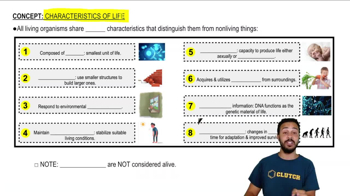
The smallest fundamental unit of life that displays all characteristics of living organisms.
The ability of an organism to maintain stable internal conditions despite changes in the external environment.
The biological process by which organisms produce new individuals, either sexually or asexually.
Hereditary material, primarily DNA, that carries instructions for growth, development, and functioning of organisms.
The molecule that contains the genetic blueprint for all living organisms.
The change in the genetic composition of populations over time, leading to adaptations and the emergence of new species.
Changes in the surroundings that living organisms can detect and respond to.
The capacity to do work, which living organisms acquire and utilize to maintain life processes.
Evolutionary changes that improve an organism’s ability to survive and reproduce in its environment.
Nonliving physical and chemical components of the environment that affect living organisms.