Skip to main content
General Biology
나의 코스
배우기
시험 준비
AI 튜터
학습 가이드
교과서적 해결책
플래시카드
탐험해 보세요
앱을 사용해 보세요
나의 코스
배우기
시험 준비
AI 튜터
학습 가이드
교과서적 해결책
플래시카드
탐험해 보세요
앱을 사용해 보세요
뒤로
Ecdysozoa: Nematodes, Arthropods, and Related Systems
카드를 뒤집기 위해 탭할 수 있습니다.
What defines Ecdysozoa?
카드를 뒤집기 위해 탭할 수 있습니다.
👆
What defines Ecdysozoa?
Ecdysozoa
are animals that grow by
molting
their exoskeleton. This group includes 8 phyla such as Arthropoda and Nematoda.
진행 상황 추적
컨트롤 버튼이 '내비게이션' 모드로 변경되었습니다.
1/20
추천 영상
02:05
Nematodes
2975
views
20
rank
1
comments
13:55
Crustaceans and Hexapods
3402
views
28
rank
08:00
Arthropods and Chelicerata
4100
views
25
rank
이 집합의 용어 (20)
하이드의 정의
What defines Ecdysozoa?
Ecdysozoa
are animals that grow by
molting
their exoskeleton. This group includes 8 phyla such as Arthropoda and Nematoda.
Name some phyla included in Ecdysozoa.
Phyla include
Arthropoda, Nematoda, Onycophora, Tardigrada, Kinorhyncha, Priapulida, Loricifera,
and
Nematomorpha
.
What is unique about Tardigrade anhydrobiosis?
Tardigrades can enter a
resting stage
called anhydrobiosis, allowing them to tolerate extreme conditions.
Describe key features of Nematodes.
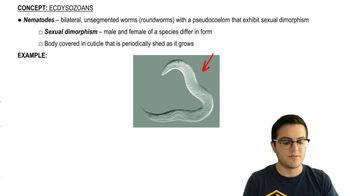
Nematodes are
unsegmented
with a
pseudocoelom
, have only
longitudinal muscles
, and are important soil organisms.
What is a model organism mentioned for Nematodes?
Caenorhabditis elegans
is a widely used model organism in biological research.
List general characteristics of Arthropods.
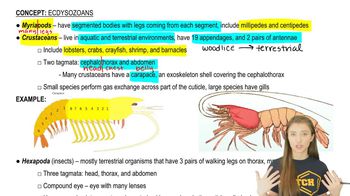
Arthropods have a
segmented
body,
jointed exoskeleton
,
reduced coelom
,
paired jointed appendages
, eyes, and antennae.
What is molting (ecdysis) in Ecdysozoa?
Molting is the process of shedding the old exoskeleton and forming a new one, involving
premolt, molting, postmolt,
and
intermolt
stages.
Describe the premolt stage in molting.
During premolt, the old skeleton is resorbed, calcium levels rise, and a new exoskeleton is secreted beneath the old one.
How is gas exchange optimized in animals?
Gas exchange is maximized by increasing surface area through
flattening, branching, folding,
and
projections
.
What are the two main types of circulatory systems?
Open circulatory systems
have blood flowing freely in body cavities, while
closed circulatory systems
have blood confined to vessels.
Describe the insect respiratory system.
Insects have a unique system where
air passages (tracheae)
reach most cells directly, bypassing the circulatory system.
How do vertebrate circulatory systems differ?
Vertebrates have more advanced systems with
3-chambered
or
4-chambered hearts
for efficient oxygen transport.
How is surface area maximized in the human respiratory system?
Surface area is maximized by
branching bronchioles
and
alveoli
, increasing gas exchange efficiency.
What is the Bohr effect?
The Bohr effect describes how a
change in pH
causes hemoglobin to release oxygen more readily.
What type of muscles do nematodes have?
Nematodes possess only
longitudinal muscles
, which produce a thrashing movement.
What is the coelom condition in arthropods?
Arthropods have a
reduced coelom
, with the main body cavity being a hemocoel.
What are paired jointed appendages?
These are limbs with joints found in arthropods, allowing complex movement and specialization.
What is the function of the exoskeleton in arthropods?
The exoskeleton provides
protection, support,
and a surface for muscle attachment.
What happens during the postmolt stage?
The new exoskeleton hardens and the body shrinks back to normal size after swelling during molting.
What is the significance of the model organism Caenorhabditis elegans?
It is used to study development, genetics, and neurobiology due to its simplicity and well-mapped genome.
 뒤로뒤로
 02:05