뒤로

Enzymes and Chemical Reactions in General Biology

컨트롤 버튼이 '내비게이션' 모드로 변경되었습니다.
1/20
  • What is an enzyme?

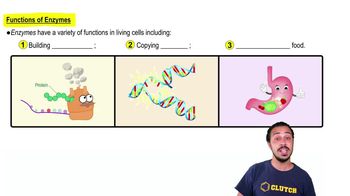
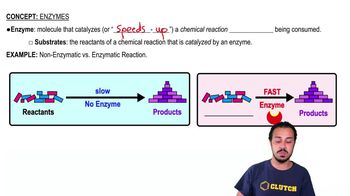
    An enzyme is a macromolecule, usually a protein, that acts as a catalyst to speed up chemical reactions without being consumed.
  • What is activation energy?

    Activation energy is the energy needed to start a chemical reaction by getting molecules to the transition state where bonds can be broken.
  • Define Gibbs free energy (G).

    Gibbs free energy is the portion of a system's energy that can perform work when temperature and pressure are uniform, such as in living cells.
  • What characterizes an exergonic reaction?

    An exergonic reaction releases free energy (ΔG < 0), is spontaneous, and the reactants have more free energy than the products.
  • Give an example of an exergonic reaction.

    Cellular respiration: \(\mathrm{C_6H_{12}O_6 + 6O_2 \rightarrow 6CO_2 + 6H_2O + energy}\).
  • What characterizes an endergonic reaction?

    An endergonic reaction absorbs free energy (ΔG > 0), is nonspontaneous, and the products have more free energy than the reactants.
  • Give an example of an endergonic reaction.

    Photosynthesis: \(\mathrm{6CO_2 + 6H_2O + energy \rightarrow C_6H_{12}O_6 + 6O_2}\).
  • How do enzymes affect activation energy and ΔG?

    Enzymes lower the activation energy of a reaction but do not change the overall ΔG or the spontaneity of the reaction.
  • What is the enzyme-substrate complex?

    It is the temporary complex formed when an enzyme binds to its substrate at the enzyme's active site.
  • What is the induced fit model?

    The enzyme undergoes a subtle change in shape after substrate binding to enhance the fit between enzyme and substrate.
  • List mechanisms by which enzymes lower activation energy.

    • Provide a template for substrate orientation
    • Stretch substrate bonds to weaken them
    • Create a favorable microenvironment
    • Participate directly in the reaction without being consumed
  • What factors affect the rate of an enzymatic reaction?

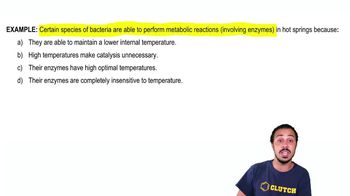
    Substrate concentration, enzyme concentration, and local conditions such as temperature and pH.
  • What are cofactors and coenzymes?

    Cofactors are non-protein helpers required for enzyme activity; organic cofactors are called coenzymes, e.g., vitamins.
  • Describe competitive inhibition.

    Competitive inhibitors reduce enzyme activity by binding to the active site, blocking substrate binding.
  • Describe noncompetitive inhibition.

    Noncompetitive inhibitors bind to a different site on the enzyme, changing its shape and reducing active site effectiveness.
  • What is allosteric regulation?

    Binding of a regulatory molecule at one site on an enzyme affects the enzyme's function at a different site, causing inhibition or stimulation.
  • Explain cooperativity in enzymes.

    A type of allosteric activation where substrate binding at one active site increases catalytic activity at other sites.
  • What is feedback inhibition?

    The end product of a metabolic pathway inhibits an enzyme within that pathway to regulate its own production.
  • Why is heat not an ideal way to speed up biological reactions?

    Heat can denature proteins and would accelerate all reactions indiscriminately, disrupting cellular function.
  • Can enzymes convert an endergonic reaction into an exergonic one?

    No, enzymes cannot change the overall free energy change or convert endergonic reactions into exergonic ones.