 뒤로
Enzymes - General Biology(Lab6Slides)
 02:32

이 집합의 용어 (20)
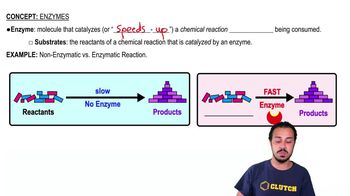
An enzyme is a biological catalyst that speeds up chemical reactions by reducing the activation energy.
Enzymes are very specific to the reactions they catalyze, unlike most chemical catalysts which are nonspecific.
By binding to reactants and stressing certain bonds that need to be broken, sometimes briefly participating in the reaction.
Substrates are the reactants that bind to an enzyme's active site to undergo a chemical reaction.
The specific location on an enzyme where the substrate binds through weak interactions like hydrogen bonds.
An interaction where the enzyme and substrate slightly modify their structures to fit together snugly.
No, enzymes are never consumed; they are recycled and can catalyze multiple reactions.
A holoenzyme is an enzyme made up of multiple parts, including the protein component and any required cofactors or coenzymes.
The protein portion of a holoenzyme that contains the active site but is inactive without cofactors or coenzymes.
Cofactors are inorganic ions or molecules (e.g., Mg2+), while coenzymes are organic compounds (e.g., NAD+) required for enzyme activity.
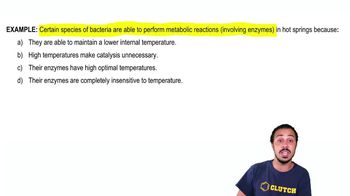
Increasing temperature increases enzyme activity up to an optimal point; beyond that, enzymes denature and activity decreases.
Denaturation is the loss of an enzyme's three-dimensional structure, causing loss of function.
Enzymes have an optimal pH; deviations above or below this cause denaturation and loss of activity.
Enzyme activity increases until a saturation point where all enzyme active sites are occupied.
The substrate concentration at which all enzyme molecules are bound to substrate, and activity plateaus.
Factors that interfere with enzyme function, either nonspecifically (e.g., temperature) or specifically by binding to enzymes.
An inhibitor that competes with the substrate for the active site and can be outcompeted by increasing substrate concentration.
An inhibitor that binds permanently to an enzyme, chemically altering it and permanently stopping its activity.
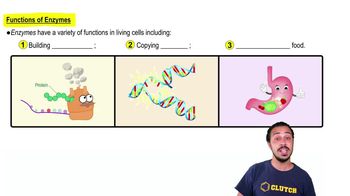
They speed up reactions by lowering activation energy, allowing life-sustaining biochemical processes to occur efficiently.
Hydrogen bonds and other weak interactions stabilize substrate binding at the enzyme's active site.