 뒤로
Evolution by Natural Selection - General Biology
 03:22

이 집합의 용어 (26)
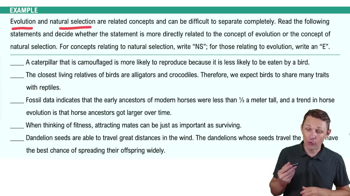
Evolution by natural selection explains how species change over time and new species arise through differential survival and reproduction of individuals with advantageous traits.
Charles Darwin and Alfred Russel Wallace independently developed the theory in the 19th century.
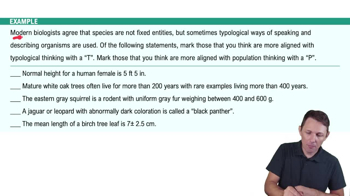
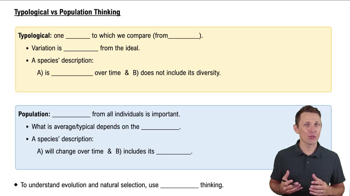
Typological thinking is the idea that every organism is a perfect, unchanging type created by a divine being, ignoring variation among individuals.
Aristotle's hierarchy arranging species by complexity, placing humans near the top just below divine beings.
Lamarck proposed that simple organisms arise by spontaneous generation and evolve progressively into more complex forms over time.
Individuals change during their lifetimes in response to the environment, and these changes are passed to offspring, e.g., giraffe neck elongation by stretching.
Species change over time due to variation among individuals; advantageous traits increase reproductive success; all life shares common ancestry; evolution is not linear.
Fossils are direct evidence of past organisms, showing change over time and documenting extinct species.
It divides Earth's history into eons, eras, periods, and epochs based on fossil evidence and radioactive dating, providing a timeline for evolutionary events.
Extinction is the disappearance of species; over 99% of species that ever lived are extinct, showing species are dynamic and not permanent.
Fossil species with traits intermediate between ancestral and derived forms, supporting gradual evolutionary change.
Reduced or nonfunctional structures similar to functional ones in related species, indicating evolutionary change.
Similar species are often found in the same geographic area, supporting common ancestry and diversification through evolution.
Similarity due to common ancestry, observed at genetic, developmental, and structural levels.
Similarity not due to shared ancestry, often from convergent evolution.
Similarity in DNA, RNA, or amino acid sequences inherited from a common ancestor.
Similarity in embryonic form or developmental processes due to common ancestry.
Similarity in adult morphology, such as bone arrangement in vertebrate limbs, due to common ancestry.
- Variation exists among individuals.
- Some trait differences are heritable.
- Survival and reproduction vary.
- Survival and reproduction are non-random; favorable traits are selected.
The ability of an individual to produce surviving, fertile offspring relative to others in the population.
A heritable trait that increases fitness in a particular environment.
During droughts, finches with larger, deeper beaks survived better due to availability of hard seeds; beak size is polygenic, influenced by genes like ALX1 and HMGA2.
Adaptations involve compromises between traits that may have conflicting effects on fitness.
Genetic correlations and pleiotropy can limit the direction and extent of evolutionary change.
Evolution is limited by traits inherited from ancestors.
Changing environments can alter which traits are favored by selection.