 뒤로
Evolutionary Processes in General Biology
 02:09

이 집합의 용어 (29)
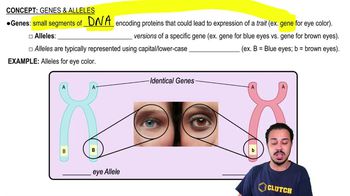
A sequence of DNA bases that codes for a protein.
Different forms of a gene that exist in a population.
The specific alleles an organism carries for a gene.
The observable characteristics of an organism resulting from its genotype and environment.
An individual with two identical alleles for a gene.
An individual with two different alleles for a gene.
The study of processes that change allele and genotype frequencies in populations.
Any change in allele frequency within a population over time.
The proportion of a specific allele among all alleles for a gene in a population.
A model predicting genotype and allele frequencies assuming no evolution occurs.
\(p + q = 1\) and \(p^2 + 2pq + q^2 = 1\), where p and q are allele frequencies.
Random mating, no gene flow, no genetic drift, no mutation, and no natural selection.
Increases homozygosity and decreases heterozygosity in a population.
Process where individuals with advantageous traits survive and reproduce more, increasing those traits' frequency.
Favors one extreme phenotype, shifting the population mean in one direction.
Favors intermediate phenotypes, reducing variation and maintaining the status quo.
Favors both extreme phenotypes over intermediates, increasing variation.
Maintains multiple alleles in a population through heterozygote advantage or frequency-dependent selection.
Heterozygotes have higher fitness than either homozygote, maintaining genetic variation.
Random changes in allele frequencies due to chance, especially in small populations.
When a new population is started by a small number of individuals, allele frequencies may differ from the original population.
A sudden reduction in population size that drastically alters allele frequencies.
Movement of alleles between populations, reducing genetic differences and introducing new alleles.
The ultimate source of new genetic variation, producing new alleles through changes in DNA.
Point mutations (single base changes) and chromosome-level mutations (duplications, deletions).
Transfer of genes between species, especially common in prokaryotes.
Nonrandom mating that increases homozygosity and can cause inbreeding depression due to deleterious alleles.
Long-term experiments show accumulation of mutations over thousands of generations at different rates.
Red and green color morphs are maintained by balancing selection due to predator preferences.