 뒤로
Fungal Diversity and Life Cycles

 08:59

이 집합의 용어 (27)
Flagellated spores distinguish chytrids, allowing them to move in aquatic environments.
Characterized by a resistant zygosporangium that acts as the sexual stage in their life cycle.
Form arbuscular mycorrhizae with plants, facilitating nutrient exchange.
Produce sexual spores called ascospores inside sac-like structures called asci. Also produce asexual spores called conidia.
Have an elaborate fruiting body called a basidiocarp containing many basidia that produce sexual spores called basidiospores.
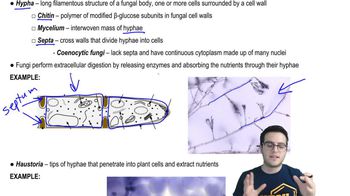
A network of hyphae that forms the main body of a fungus, often found in soil or decaying material.
Structures such as mushrooms or sporangia that produce and release spores for reproduction.
Involves plasmogamy (fusion of cytoplasm), karyogamy (fusion of nuclei), and meiosis to produce haploid spores.
Occurs via mitotic production of spores or budding, allowing rapid colonization without genetic recombination.
Acts as a resistant structure during sexual reproduction in zygomycetes, protecting the zygote until conditions are favorable.
The fruiting body of basidiomycetes, often visible as mushrooms, where basidia produce basidiospores.
A sac-like structure in ascomycetes where meiosis occurs to produce ascospores.
Asexual spores produced externally on specialized hyphae called conidiophores in ascomycetes.
Mutualistic associations formed by glomeromycetes with plant roots, enhancing nutrient uptake.
Reproductive units that can be sexual or asexual, dispersed to colonize new environments.
Threadlike filaments that make up the mycelium of a fungus, facilitating nutrient absorption.
The fusion of cytoplasm from two parent mycelia during fungal sexual reproduction.
The fusion of nuclei from two parent mycelia, resulting in a diploid zygote.
Includes haploid, dikaryotic (n + n), and diploid stages, with meiosis restoring haploidy.
A fungal life cycle phase where cells contain two distinct haploid nuclei before karyogamy.
Include decomposers, mutualists (e.g., mycorrhizae), and pathogens.
Fungi form symbiotic relationships like mycorrhizae, improving plant nutrient absorption.
About 30% of fungi are parasites or pathogens, mostly affecting plants and sometimes animals.
Occurs by simple cell division or budding, without spore formation.
Spores are released into the environment to germinate and form new mycelia.
Structures like mushrooms that produce and release spores for reproduction.
Major groups include Chytridiomycota, Zygomycota, Glomeromycota, Ascomycota, and Basidiomycota.