 뒤로
Gene Expression in General Biology
 05:45

이 집합의 용어 (20)
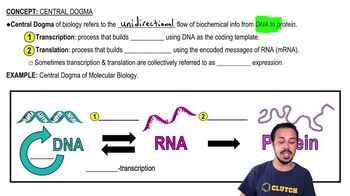
The unidirectional flow of biochemical information from DNA to RNA to protein.
Transcription: DNA is used to build RNA.
Translation: RNA is used to build proteins.
RNA polymerase binds to the promoter and synthesizes RNA by polymerizing nucleotides from scratch without a primer.
Promoter: DNA sequence where transcription starts.
Terminator: DNA sequence where transcription ends.
The coding strand has the same sequence as the RNA transcript (with T replaced by U). The template strand is used by RNA polymerase to build RNA.
1) Initiation: RNA polymerase binds promoter.
2) Elongation: RNA strand is synthesized.
3) Termination: RNA transcript is released.
Addition of a 5’ cap and a poly-A tail to pre-mRNA to protect it and facilitate export and translation.
Removal of noncoding introns from pre-mRNA and joining of coding exons to form mature mRNA.
mRNA: carries genetic code for proteins.
rRNA: forms ribosome structure.
tRNA: transfers amino acids during translation.
mRNA codons (triplets) correspond to specific amino acids or stop signals, decoded by tRNA anticodons during translation.
A-site: holds incoming aminoacyl-tRNA.
P-site: holds tRNA with growing polypeptide.
E-site: exit site for discharged tRNA.
1) Initiation: ribosome assembles on mRNA.
2) Elongation: amino acids added to polypeptide.
3) Termination: release factor binds stop codon and polypeptide is released.
The start codon is AUG, which codes for Methionine (Met).
Covalent changes to proteins after translation, such as phosphorylation, methylation, acetylation, and ubiquitination, that regulate protein function.
A permanent change in the DNA sequence that can affect gene expression and protein function.
Introns are noncoding regions removed during RNA splicing.
Exons are coding regions that remain in mature mRNA.
A complex of RNA and proteins that removes introns from pre-mRNA during splicing.
It allows a single gene to produce multiple different mRNA and protein variants.
They are complementary to mRNA codons and ensure the correct amino acid is added during translation.
Mutations can be harmful, beneficial, or neutral by altering the amino acid sequence and protein function.