 뒤로
General Biology: Animal Behavior, Ecology, and Ecosystems
 07:15

이 집합의 용어 (28)
1. What stimulus elicits the behavior and what physiological mechanisms mediate it?
2. How does experience during growth influence the response?
3. How does the behavior increase survival and reproduction?
4. What is the behavior's evolutionary history?
Proximate causation explains how a behavior occurs, focusing on physiological and anatomical responses to stimuli derived from genes.
Ultimate causation explains why a behavior occurs, focusing on its adaptive advantage and evolutionary significance.
A fixed action pattern is an unchangeable, innate behavior triggered by a specific external cue (sign stimulus) and carried to completion once started.
Male three-spined stickleback fish attack anything red due to a fixed action pattern triggered by the red belly (sign stimulus).
Taxis is movement toward or away from a stimulus. Migration is a regular, long-distance movement often linked to seasons or circadian rhythms.
Animals orient using the position of the sun and circadian clock, the position of stars, and Earth's magnetic field.
The waggle dance is a communication behavior that conveys the distance and direction of a food source using the angle relative to the sun.
Imprinting is a learned behavior occurring during a sensitive period early in life, where an animal forms a strong attachment to a specific stimulus or individual.
Associative learning is when an animal links one environmental feature with another, such as avoiding certain colors after a bad experience.
R-selected species reproduce early with many offspring and little parental care. K-selected species reproduce later with fewer offspring and more parental care.
Carrying capacity is the maximum population size an environment can sustain indefinitely.
Exponential growth is rapid, unlimited growth (J-shaped curve). Logistic growth levels off as population reaches carrying capacity (S-shaped curve).
Factors that affect population size more strongly as population density increases, such as competition, predation, and disease.
Competitive exclusion occurs when two species compete for the same limited resource and one species outcompetes and excludes the other.
Resource partitioning is when species evolve to use different parts or times of a resource to reduce competition.
Batesian mimicry is when a harmless species mimics the appearance of a harmful or unpalatable species to avoid predation.
Mutualism is a symbiotic relationship where both species benefit, e.g., acacia trees and stinging ants.
A keystone species has a large impact on community structure despite low abundance, often by controlling populations of other species.
Energy cannot be created or destroyed, only transferred or transformed within an ecosystem.
NPP is the energy remaining after autotrophs use some for respiration; it represents energy available to consumers.
Because energy is lost as heat and used for metabolism, only about 10% of energy is converted into biomass at the next trophic level.
They convert atmospheric nitrogen into forms usable by plants, enhancing soil fertility (e.g., Rhizobium in legume root nodules).
Ecological succession is the gradual process of change in species composition in a community over time after a disturbance.
Primary succession occurs where no soil exists (e.g., after a volcanic eruption). Secondary succession occurs where soil remains after disturbance (e.g., after a fire).
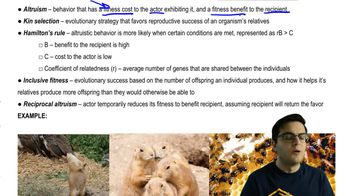
Altruism is behavior that reduces an individual's fitness while increasing the fitness of others, often relatives.
Hamilton's rule predicts altruism occurs when \(rB > C\), where r is relatedness, B is benefit to recipient, and C is cost to actor.
Moderate levels of disturbance increase species diversity by preventing competitive exclusion and allowing coexistence.