Animals are heterotrophic eukaryotes, multicellular, have tissues from embryonic layers, mostly reproduce sexually, and possess Hox developmental genes.
Kingdom of consumers
Animals are efficient consumers with adaptations to detect, capture, eat, and digest other organisms, e.g., chameleons use a long, sticky tongue to catch insects.
Animal cell structure
Animal cells lack cell walls and are supported by collagen. Unique tissues include nervous and muscle tissues.
Animal reproduction and development
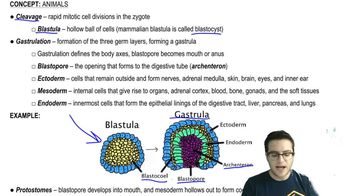
Most animals reproduce sexually with a dominant diploid stage. Fertilization leads to cleavage, forming a hollow blastula, which undergoes gastrulation to form embryonic tissue layers.
Hox genes
Hox genes regulate body form development and are conserved across animals, enabling diverse morphologies.
Common ancestor of animals
Animals likely evolved from protists called choanoflagellates, sharing genes for cell adhesion and signaling.
Cambrian explosion
Occurred 535–525 million years ago, marking the rapid appearance of many animal phyla, especially bilaterians with bilateral symmetry and complete digestive tracts.
Animal body plans
Body plans include symmetry types: radial symmetry (top and bottom, no left/right) and bilateral symmetry (distinct left/right, front/back).
Radial vs bilateral symmetry
Radial animals are often sessile or planktonic (e.g., cnidarians), while bilateral animals are typically active movers with a central nervous system.
Germ layers in animals
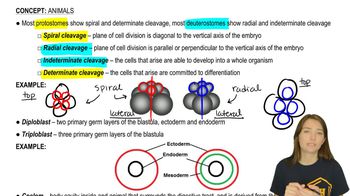
Animals develop from 3 germ layers: ectoderm (outer layer), endoderm (inner layer), and mesoderm (middle layer, only in bilaterians).
Diploblastic vs triploblastic
Diploblastic animals have ectoderm and endoderm (e.g., cnidarians). Triploblastic animals have all three germ layers including mesoderm (all bilaterians).
Body cavities
Most triploblastic animals have a body cavity called a coelom, derived from mesoderm, which cushions organs and allows independent movement.
Types of body cavities
Coelomates have a true coelom, pseudocoelomates have a body cavity not fully lined by mesoderm, and acoelomates lack a body cavity.
Protostome vs deuterostome development
Protostomes have spiral, determinate cleavage; mouth develops from blastopore. Deuterostomes have radial, indeterminate cleavage; anus develops from blastopore.
Cleavage types
Protostomes exhibit spiral and determinate cleavage; deuterostomes exhibit radial and indeterminate cleavage.
Significance of indeterminate cleavage
Indeterminate cleavage allows each early embryonic cell to develop into a complete embryo, enabling identical twins and embryonic stem cells.
Animal phylogeny key points
All animals share a common ancestor; sponges are basal; eumetazoa have tissues; most animals are bilaterians; bilaterians include invertebrates and vertebrates.
Major animal clades
Bilateria divides into three major clades: Lophotrochozoa, Ecdysozoa, and Deuterostomia.
Phylum Porifera
Sponges lack true tissues and have choanocytes (collar cells) that ingest bacteria and tiny food particles.
Phylum Cnidaria
Cnidarians are diploblastic, radially symmetrical, have nematocytes (stinging cells), and a gastrovascular cavity with one opening.
Phylum Platyhelminthes
Flatworms are dorsoventrally flattened acoelomates with a gastrovascular cavity or no digestive tract.
Phylum Rotifera
Rotifers are pseudocoelomates with an alimentary canal, jaws (trophi), and a head with a ciliated crown.
Phylum Mollusca
Mollusks are coelomates with a muscular foot, visceral mass, mantle, reduced coelom, and most have a calcium carbonate shell.
Phylum Annelida
Segmented worms with a segmented body wall and internal organs, except the digestive tract which is unsegmented.
Phylum Nematoda
Roundworms are cylindrical pseudocoelomates with tapered ends, no circulatory system, and undergo ecdysis (molting).
Phylum Arthropoda
Arthropods have segmented bodies, jointed appendages, and an exoskeleton made of protein and chitin.
Phylum Echinodermata
Echinoderms have bilaterally symmetrical larvae, five-part adult body organization, a water vascular system, and an endoskeleton.
Phylum Chordata
Chordates have a notochord, dorsal hollow nerve cord, pharyngeal slits, and a post-anal tail.
 뒤로
 06:59