Skip to main content
General Biology
나의 코스
배우기
시험 준비
AI 튜터
학습 가이드
교과서적 해결책
플래시카드
탐험해 보세요
앱을 사용해 보세요
나의 코스
배우기
시험 준비
AI 튜터
학습 가이드
교과서적 해결책
플래시카드
탐험해 보세요
앱을 사용해 보세요
뒤로
General Biology: Biomolecules and Macromolecules
카드를 뒤집기 위해 탭할 수 있습니다.
What are the four main classes of biological macromolecules?
카드를 뒤집기 위해 탭할 수 있습니다.
👆
What are the four main classes of biological macromolecules?
Nucleic acids
,
Proteins
,
Carbohydrates
, and
Lipids
.
진행 상황 추적
컨트롤 버튼이 '내비게이션' 모드로 변경되었습니다.
1/20
추천 영상
03:35
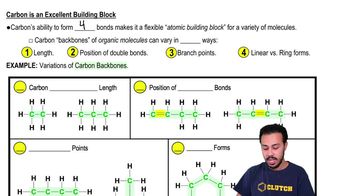
Carbon is an Excellent Building Block
22860
views
908
rank
04:19
Carbon
30093
views
713
rank
2
comments
이 집합의 용어 (20)
하이드의 정의
What are the four main classes of biological macromolecules?
Nucleic acids
,
Proteins
,
Carbohydrates
, and
Lipids
.
What is a polymer and what are its building blocks?
A
polymer
is a large molecule made of repeating smaller units called
monomers
.
What process links monomers to form polymers?
Dehydration synthesis
(condensation) removes water to form a new bond between monomers.
How are polymers broken down into monomers?
Hydrolysis
adds water to break bonds, releasing monomers from polymers.
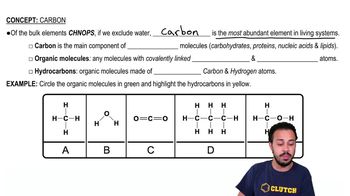
Why is carbon essential in biological molecules?
Carbon can form
four covalent bonds
, allowing complex, branched molecules with diverse shapes and functions.
What is a functional group in organic molecules?
A
functional group
is a specific group of atoms that participates in chemical reactions and determines molecule properties.
Name three important functional groups in biomolecules.
Hydroxyl (-OH)
,
Carboxyl (-COOH)
, and
Amino (-NH2)
groups.
What is the monomer and polymer of carbohydrates?
Monomer:
Monosaccharide
; Polymer:
Polysaccharide
.
What are the monomers and polymers of proteins?
Monomers:
Amino acids
; Polymers:
Polypeptides
or
Proteins
.
What type of bond links amino acids in a protein?
A
peptide bond
formed by dehydration synthesis links amino acids.
What determines the unique properties of amino acids?
The
side chain (R group)
determines amino acid polarity, charge, and behavior.
What are the four levels of protein structure?
Primary
(amino acid sequence),
Secondary
(alpha helices and beta sheets),
Tertiary
(3D folding), and
Quaternary
(multi-subunit assembly).
How do changes in pH or temperature affect proteins?
They can
denature
proteins by disrupting hydrogen and ionic bonds, causing loss of structure and function.
What is the monomer and polymer of nucleic acids?
Monomer:
Nucleotide
; Polymer:
DNA
or
RNA
.
What are the three parts of a nucleotide?
A
sugar
, a
phosphate group
, and a
nitrogenous base
.
What is the difference between DNA and RNA sugars?
DNA contains
deoxyribose
(lacking 2' OH), RNA contains
ribose
(with 2' OH).
Which nitrogenous bases are purines and which are pyrimidines?
Purines:
Adenine (A), Guanine (G);
Pyrimidines:
Cytosine (C), Thymine (T), Uracil (U).
How do bases pair in DNA?
A pairs with T via two hydrogen bonds; G pairs with C via three hydrogen bonds.
What type of bond links nucleotides in a nucleic acid strand?
Phosphodiester bonds
link the 3' hydroxyl of one sugar to the 5' phosphate of the next.
What is ATP and why is it important?
Adenosine triphosphate (ATP)
is the cell's main energy currency, providing energy for cellular processes.
 뒤로뒤로
 03:35