Skip to main content
General Biology
나의 코스
배우기
시험 준비
AI 튜터
학습 가이드
교과서적 해결책
플래시카드
탐험해 보세요
앱을 사용해 보세요
나의 코스
배우기
시험 준비
AI 튜터
학습 가이드
교과서적 해결책
플래시카드
탐험해 보세요
앱을 사용해 보세요
뒤로
General Biology: Cell Anatomy and Membrane Transport
카드를 뒤집기 위해 탭할 수 있습니다.
What are the two fundamental types of cells based on morphology?
카드를 뒤집기 위해 탭할 수 있습니다.
👆
What are the two fundamental types of cells based on morphology?
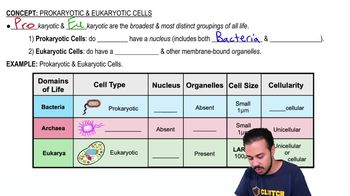
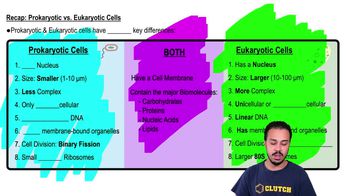
Eukaryotes
have a membrane-bound nucleus;
Prokaryotes
lack a membrane-bound nucleus.
진행 상황 추적
컨트롤 버튼이 '내비게이션' 모드로 변경되었습니다.
1/30
추천 영상
04:26
Recap: Prokaryotic vs. Eukaryotic Cells
24471
views
419
rank
05:54
Prokaryotic & Eukaryotic Cells
40677
views
895
rank
4
comments
03:54
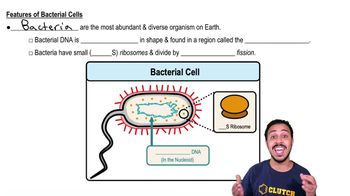
Features of Bacterial Cells
29698
views
524
rank
1
comments
이 집합의 용어 (30)
하이드의 정의
What are the two fundamental types of cells based on morphology?
Eukaryotes
have a membrane-bound nucleus;
Prokaryotes
lack a membrane-bound nucleus.
Name the three domains of life based on phylogeny.
Bacteria
(prokaryotic),
Archaea
(prokaryotic), and
Eukarya
(eukaryotic).
What are key components of prokaryotic cells?
At least one chromosome, many protein-synthesizing ribosomes, and sometimes internal photosynthetic membranes.
What is the primary structural component of bacterial cell walls?
Peptidoglycan
, a tough polysaccharide layer surrounding the plasma membrane.
What external structures enable prokaryotic movement and attachment?
Flagella
for propulsion and
fimbriae
for attachment to surfaces or other cells.
What defines a eukaryotic cell?
A cell with a membrane-bound nucleus and membrane-bound organelles with specialized functions.
What is the plasma membrane composed of?
A
phospholipid bilayer
with embedded proteins, cholesterol, and sometimes glycolipids.
What is the function of the cytoskeleton?
Maintains cell shape, secures organelles, enables cytoplasm and vesicle movement, and allows cell motility.
What roles do vesicles and vacuoles play in cells?
Membrane-bound sacs for storage and transport; central vacuole regulates water concentration and provides structural support in plants.
What is housed inside the nucleus?
The cell's DNA in chromatin form; it directs ribosome and protein synthesis.
What is the nucleolus responsible for?
Assembly of ribosomal RNA and ribosome subunits.
What is the endomembrane system?
A group of membranes and organelles that modify, package, and transport lipids and proteins within eukaryotic cells.
What are ribosomes and their function?
Cellular structures responsible for protein synthesis.
Differentiate between rough and smooth endoplasmic reticulum (ER).
Rough ER has ribosomes for protein modification; smooth ER synthesizes lipids and lacks ribosomes.
What is the Golgi apparatus?
A series of flattened membranous sacs that modify, sort, and package proteins and lipids.
What is the function of lysosomes?
Contain digestive enzymes to break down cellular waste and macromolecules.
What do peroxisomes do?
Carry out oxidation reactions to break down fatty acids and detoxify poisons.
What is the role of mitochondria?
Produce ATP, the cell's main energy-carrying molecule.
What is the function of chloroplasts?
Conduct photosynthesis, converting CO2, water, and light into glucose.
What does the endosymbiosis theory propose?
Mitochondria and chloroplasts originated as free-living bacteria engulfed by ancestral eukaryotes, forming a mutualistic relationship.
What is the fluid mosaic model of the plasma membrane?
A phospholipid bilayer with embedded proteins, cholesterol, and carbohydrates that create a flexible, selectively permeable membrane.
What is passive transport?
Movement of substances across membranes without energy input, down their concentration gradient.
Define osmosis.
Diffusion of water molecules through a semipermeable membrane.
What is tonicity?
The relative concentration of solutes in a solution compared to another, affecting water movement.
What is facilitated diffusion?
Passive transport requiring protein channels to move substances down their concentration gradient.
What is active transport?
Energy-requiring process moving substances against their concentration gradient, often using ATP.
Describe the sodium-potassium pump.
An active transport protein that moves Na+ out and K+ into the cell against their gradients using ATP.
What is secondary active transport?
Uses electrochemical gradients set up by primary active transport to move other molecules against their gradient without direct ATP use.
What is endocytosis?
Active transport process where cells engulf large particles or fluids; includes phagocytosis and pinocytosis.
What is exocytosis?
Process by which cells expel materials in vesicles by fusing them with the plasma membrane.
 뒤로뒤로
 04:26