 뒤로
General Biology: Cell Cycle, Mitosis & Meiosis
 04:45

이 집합의 용어 (25)
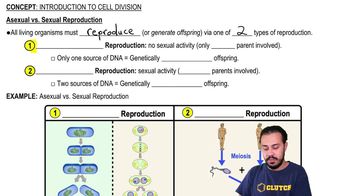
Involves a single parent. Offspring are genetically identical clones produced by budding, fission, or fragmentation.
Involves two parents contributing gametes. Offspring have unique gene combinations, increasing genetic variation.
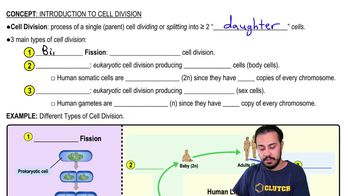
Prokaryotes replicate their single circular chromosome, elongate, then divide into two genetically identical daughter cells.
Prokaryotes have a single circular chromosome in the nucleoid; eukaryotes have multiple linear chromosomes in a nucleus.
Interphase (G1, S, G2) for growth and DNA replication; Mitotic phase (Mitosis and Cytokinesis) for cell division.
Cell grows and performs normal functions before DNA replication.
DNA is replicated; each chromosome forms sister chromatids.
Cell continues to grow and prepares for mitosis.
Prophase, Prometaphase, Metaphase, Anaphase, Telophase; chromosomes condense, align, separate, and nuclei reform.
Occurs via a cleavage furrow where a contractile ring pinches the cell into two.
Occurs via a cell plate formed by vesicles that create a new cell wall between daughter cells.
Cancer cells divide uncontrollably, ignore growth signals, and can invade tissues; healthy cells divide only when needed.
Benign tumors stay localized; malignant tumors invade tissues and spread (metastasize).
Body cells that are diploid (2n), containing pairs of homologous chromosomes; humans have 2n = 46.
Sex cells (egg and sperm) that are haploid (n), containing one set of chromosomes; humans have n = 23.
Diploid (2n) cells have two chromosome sets; haploid (n) cells have one set.
Homologous chromosomes pair and separate, crossing over occurs, resulting in two haploid cells with duplicated chromosomes.
Sister chromatids separate, producing four genetically unique haploid cells.
Mitosis: one division, no homolog pairing, produces 2 diploid identical cells. Meiosis: two divisions, homolog pairing, crossing over, produces 4 haploid unique cells.
Independent orientation at metaphase I, crossing over in prophase I, and random fertilization.
Failure of chromosome pairs or sister chromatids to separate during meiosis, causing abnormal chromosome numbers in gametes.
Deletion, duplication, inversion, and translocation of chromosome fragments.
Most cancer mutations occur in somatic cells and are not inherited; only germline mutations are passed to offspring.
Calculated as \(2^n\), where \(n\) is the haploid chromosome number.
Humans have \(n=23\), so possible gamete combinations are \(2^{23}\).