 뒤로
General Biology: Cell Division and Genetics Vocabulary
 04:45

이 집합의 용어 (33)
Anaphase is the stage in cell division when sister chromatids separate and move to opposite poles of the cell.
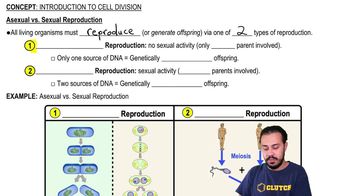
Asexual reproduction is the creation of genetically identical offspring by a single parent without sperm and egg, producing clones.
Cancer cells divide excessively to form tumors, can invade tissues, and often have faulty cell cycle control allowing indefinite division.
Autosomes are all non-sex chromosomes; humans have 22 autosomes plus one sex chromosome per gamete.
A benign tumor is a mass of abnormally growing cells that remain at the original site and do not invade other tissues.
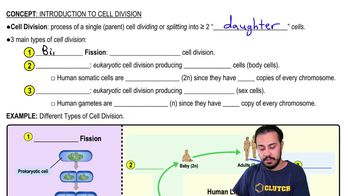
Binary fission is asexual cell division in prokaryotes where one cell divides into two genetically identical daughter cells.
The cell cycle is a sequence of growth and division phases controlled by checkpoints determining if a cell divides.
The cell cycle control system is a set of proteins that trigger and coordinate key events in the cell cycle, integrating signals to pass checkpoints.
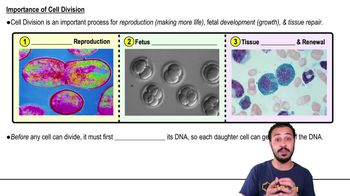
Cell division is the process where duplicated chromosomes separate so each daughter cell gets a complete set; normal cells stop dividing when crowded.
The cell plate forms during cytokinesis in plant cells and becomes the new cell wall separating daughter cells.
The centromere is the region where sister chromatids are joined and spindle fibers attach during mitosis and meiosis.
A chiasma is the visible site where crossing over occurs between homologous chromatids during prophase I of meiosis.
Chromatin is the DNA-protein complex in eukaryotic cells; it is diffuse during interphase and condenses into chromosomes before division.
A chromosome is a gene-carrying structure made of DNA and proteins, visible during mitosis and meiosis.
The cleavage furrow is the first sign of cytokinesis in animal cells, a shallow groove near the metaphase plate.
Crossing over is the exchange of chromosome segments between homologous chromatids during prophase I of meiosis.
Cytokinesis is the division of the cytoplasm forming two separate daughter cells, usually occurring with telophase.
Diploid cells have two homologous sets of chromosomes (2n), one from each parent.
Fertilization is the union of sperm and egg nuclei producing a diploid zygote.
A gamete is a haploid sex cell (egg or sperm) containing one set of chromosomes.
Haploid cells have one set of chromosomes (n), as in gametes produced by meiosis.
Homologous chromosomes are pairs of chromosomes of the same length and genes, one inherited from each parent.
Interphase is the cell cycle phase when the cell grows and prepares for division but is not dividing.
A karyotype is an arranged display of metaphase chromosomes used to identify chromosomal abnormalities.
A locus is the specific location of a gene on a chromosome; homologous chromosomes have corresponding loci.
A malignant tumor is a cancerous mass that can invade nearby tissues and spread to other body parts.
Meiosis is the division of a diploid nucleus into four haploid daughter nuclei producing gametes.
Mitosis is the division of a nucleus into two genetically identical nuclei, part of the M phase.
Nondisjunction is the failure of chromosome pairs or sister chromatids to separate during anaphase.
A sex chromosome determines an individual's sex; humans have X and Y chromosomes.
Sister chromatids are identical copies of a duplicated chromosome joined at the centromere.
Telophase is the final mitosis stage when daughter nuclei form at opposite poles, usually with cytokinesis.
A zygote is the diploid fertilized egg formed by the union of sperm and egg nuclei.