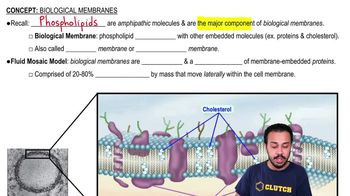
What is the plasma membrane and its primary function?
The plasma membrane is present in all cells and regulates traffic across the cell, controlling what enters and leaves.
Define simple diffusion.
Simple diffusion is the passive movement of solute molecules down their concentration gradient through the phospholipid bilayer without assistance.
Define osmosis.
Osmosis is the diffusion of the solvent (water) down its concentration gradient across a selectively permeable membrane.
What is the difference between hypertonic, hypotonic, and isotonic solutions?
Hypertonic: more solute; Hypotonic: less solute; Isotonic: equal solute concentration compared to another solution.
What happens to water movement when a cell is placed in a hypertonic solution?
Water moves out of the cell to the hypertonic solution, causing the cell to shrink.
What is facilitated diffusion?
Facilitated diffusion is passive transport where molecules move down their concentration gradient through membrane proteins because they cannot pass the lipid bilayer directly.
How does facilitated diffusion compare to simple diffusion in speed?
Facilitated diffusion is faster than simple diffusion due to the use of specific transport proteins.
What factors affect the ease of molecule passage through the phospholipid bilayer?
Smaller and more hydrophobic molecules pass more easily through the phospholipid bilayer.
Describe the fluid mosaic model of the plasma membrane.
The plasma membrane is fluid due to unsaturated fatty acids and mosaic because of embedded proteins, sugars on the extracellular side, cytoskeleton on the cytosolic side, and cholesterol.
Why is the plasma membrane described as asymmetric?
Because sugars are only on the extracellular side, cytoskeleton filaments are on the cytosolic side, and protein composition differs between sides.
What are integral and peripheral proteins in the plasma membrane?
Integral proteins span the membrane and are involved in transport and signaling; peripheral proteins are attached to the membrane surface and provide structural support.
What is the role of glycoproteins in the plasma membrane?
Glycoproteins are involved in cell-cell recognition and are part of the membrane's sugar coating.
What is active transport and how does it differ from passive transport?
Active transport moves substances against their concentration gradient and requires ATP, unlike passive transport which moves substances down the gradient without ATP.
Give an example of active transport in cells.
The Na+/K+ pump actively transports 3 Na+ ions out and 2 K+ ions into the cell using ATP.
What happens to a dialysis bag containing a solution hypertonic to its surrounding solution?
Water moves into the bag, increasing its mass as it is hypotonic relative to the outside.
What is the effect of a solution isotonic to the cell on water movement?
There is no net water movement; water levels remain stable.
What is the difference between simple diffusion and facilitated diffusion regarding membrane permeability?
Simple diffusion allows small hydrophobic molecules to pass directly; facilitated diffusion requires protein channels for molecules that cannot cross the lipid bilayer.
How does the presence of unsaturated fatty acids affect membrane fluidity?
More unsaturated fatty acids increase membrane fluidity by preventing tight packing of lipids.
What is the significance of cholesterol in the plasma membrane?
Cholesterol modulates membrane fluidity and stability by embedding randomly within the phospholipid bilayer.
What determines whether a molecule will undergo simple or facilitated diffusion?
Molecule size, polarity, and hydrophobicity determine if it can pass directly or needs protein assistance.
 뒤로
 02:21