 뒤로
General Biology: Cell Membrane Transport and Osmoregulation
 06:25

이 집합의 용어 (35)
Osmoregulation is the regulation of solute concentrations and water balance by a cell or organism.
An isotonic solution causes no net movement of water into or out of a cell when surrounding it.
A hypotonic solution causes a cell to take up water when surrounding it.
A hypertonic solution causes a cell to lose water when surrounding it.
Tonicity is the ability of a solution surrounding a cell to cause that cell to gain or lose water.
Osmosis is the diffusion of free water across a selectively permeable membrane.
Diffusion is the random thermal motion of particles resulting in net movement from higher to lower concentration.
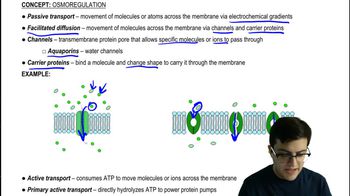
Passive transport is diffusion of a substance across a membrane without energy expenditure.
Facilitated diffusion is passive transport assisted by specific transmembrane proteins, requiring no energy.
Active transport moves substances against their concentration or electrochemical gradient using energy and transport proteins.
An electrogenic pump is an active transport protein that generates voltage across a membrane while pumping ions.
The sodium-potassium pump actively transports sodium out and potassium into animal cells, maintaining membrane potential.
A proton pump uses ATP to transport hydrogen ions out of a cell, generating membrane potential.
A concentration gradient is a region where the density of a chemical substance increases or decreases.
An electrochemical gradient combines concentration difference and membrane potential affecting ion diffusion.
Selective permeability allows biological membranes to regulate passage of substances across them.
The fluid mosaic model describes membranes as protein molecules drifting laterally in a fluid phospholipid bilayer.
An integral protein spans the membrane with hydrophobic and hydrophilic regions, often forming channels.
A peripheral protein is loosely bound to the membrane surface or integral proteins, not embedded in the bilayer.
A transport protein helps specific substances cross the membrane.
An ion channel allows specific ions to diffuse down their electrochemical gradient.
A gated channel opens or closes in response to a stimulus.
Aquaporins are channel proteins that facilitate osmosis by allowing water to cross membranes.
Cotransport couples downhill diffusion of one substance to uphill transport of another against its gradient.
Endocytosis is cellular uptake of molecules via vesicle formation from the plasma membrane.
Phagocytosis is endocytosis of large particles or organisms by cells like macrophages.
Pinocytosis is endocytosis of extracellular fluid and dissolved solutes.
Receptor-mediated endocytosis uses vesicles with receptors to selectively take in specific molecules.
Exocytosis is secretion of molecules by fusion of vesicles with the plasma membrane.
A turgid cell is swollen due to water uptake when its water potential is lower than surroundings.
A flaccid cell is limp, losing water when its water potential is higher than surroundings.
Plasmolysis is when a walled cell's cytoplasm shrivels and membrane pulls from the wall due to water loss.
An amphipathic molecule has both hydrophilic and hydrophobic regions.
A glycoprotein is a protein with covalently attached carbohydrates.
A glycolipid is a lipid with covalently attached carbohydrates.