 뒤로
General Biology: Cell Membranes and Transport
 02:21

이 집합의 용어 (18)
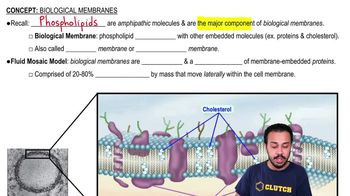
Biological membranes are primarily composed of a phospholipid bilayer with embedded proteins, cholesterol, and carbohydrates, providing a flexible and selective barrier.
They regulate the passage of substances, facilitate communication, and maintain the cell's internal environment.
The membrane is a fluid phospholipid bilayer with a mosaic of proteins that move laterally, allowing flexibility and dynamic function.
Small, nonpolar molecules like oxygen and carbon dioxide can freely diffuse across the membrane.
Large, polar, or charged molecules such as ions and glucose require transport proteins to cross.
Movement of molecules down their concentration gradient without energy input.
Movement of molecules against their concentration gradient using energy, usually from ATP.
Passive movement of molecules from an area of high concentration to low concentration until equilibrium is reached.
Diffusion of water across a selectively permeable membrane from low to high solute concentration.
In a hypotonic solution, animal cells may burst; in hypertonic, they shrink.
In hypotonic solutions, plant cells become turgid; in hypertonic, they undergo plasmolysis.
Uses ATP to directly pump molecules across membranes against their gradient.
Uses the gradient of one molecule to drive the transport of another molecule against its gradient.
Process where cells expel materials by vesicles fusing with the plasma membrane.
Process where cells engulf materials by forming vesicles from the plasma membrane.
Target cell detects a signaling molecule via a specific receptor protein.
Receptor activates a series of molecular events that relay the signal inside the cell.
Cell performs a specific action such as gene expression or metabolic change in response to the signal.