뒤로

General Biology: Cell Membranes, Signaling, Nervous System, and Senses

컨트롤 버튼이 '내비게이션' 모드로 변경되었습니다.
1/28
  • Fluid-mosaic model of cell membranes

    Describes the membrane as a fluid combination of lipids and proteins that move laterally, creating a dynamic and flexible structure.
  • Major components of eukaryotic plasma membrane

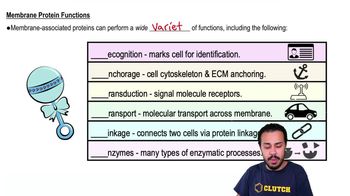
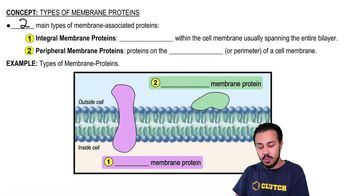
    Phospholipid bilayer (barrier), membrane proteins (transport, signaling), cholesterol (fluidity), and carbohydrates (cell recognition).
  • Passive transport vs active transport

    Passive transport moves substances down their concentration gradient without energy; active transport requires energy to move substances against the gradient.
  • Osmosis

    The diffusion of water across a semipermeable membrane from low to high solute concentration.
  • Tonicity and water movement

    Hypertonic: water leaves cell; Hypotonic: water enters cell; Isotonic: no net water movement.
  • Sodium-potassium pump function

    Uses ATP to pump 3 Na+ out and 2 K+ into the cell, maintaining electrochemical gradients essential for cell function.
  • Electrochemical gradient

    Combined effect of concentration gradient and electrical charge difference across a membrane influencing ion movement.
  • Facilitated diffusion

    Passive transport of molecules across membranes via specific transport proteins or channels.
  • Exocytosis vs endocytosis

    Exocytosis exports materials via vesicles; endocytosis imports materials by engulfing them with the membrane.
  • Paracrine, synaptic, and endocrine signaling

    Paracrine and synaptic are local signals; endocrine signaling is long-distance via hormones in the bloodstream.
  • Three stages of cell signaling

    Reception (signal detected), transduction (signal relayed and amplified), and response (cellular action).
  • G protein-coupled receptor signaling pathway

    Ligand binds receptor, activates G protein, which triggers downstream effectors to produce a cellular response.
  • Signal transduction purpose

    Converts an extracellular signal into a specific intracellular response, often amplifying the signal.
  • Second messengers (e.g., cAMP)

    Small molecules that relay signals inside the cell, amplifying and distributing the signal.
  • Hormones

    Chemical messengers secreted by endocrine glands that regulate physiology and behavior.
  • Water-soluble vs lipid-soluble hormone pathways

    Water-soluble hormones bind membrane receptors; lipid-soluble hormones cross membranes and bind intracellular receptors.
  • Negative feedback in hormone regulation

    A process where the output of a system inhibits its own production to maintain homeostasis.
  • Neuron resting membrane potential

    The voltage difference across the membrane at rest, maintained by ion gradients and leak channels.
  • Action potential generation steps

    Depolarization (Na+ channels open), peak, repolarization (K+ channels open), hyperpolarization, and return to resting potential.
  • Role of voltage-gated ion channels in neurons

    Open or close in response to voltage changes, enabling action potentials to propagate along the axon.
  • Functions of Schwann cells and oligodendrocytes

    Both produce myelin; Schwann cells myelinate PNS axons, oligodendrocytes myelinate CNS axons.
  • Four basic components of sensory systems

    Reception (detect stimulus), transduction (convert to electrical signal), transmission (send signal), perception (interpret signal).
  • Relationship between stimulus intensity and action potential frequency

    Stronger stimuli increase the frequency of action potentials, not their size.
  • Types of sensory receptors and stimuli

    Mechanoreceptors (touch), photoreceptors (light), chemoreceptors (chemicals), thermoreceptors (temperature), nociceptors (pain).
  • Role of ligand-gated ion channels in nerve conduction

    Open in response to neurotransmitters, causing graded potentials that can trigger action potentials.
  • Integration of stimuli at the axon hillock

    The axon hillock sums excitatory and inhibitory inputs to decide if threshold for action potential is reached.
  • Difference between tropic and non-tropic hormones

    Tropic hormones regulate other endocrine glands; non-tropic hormones act directly on target cells.
  • Antagonistic hormones

    Pairs of hormones with opposite effects that help maintain homeostasis.