Skip to main content
General Biology
나의 코스
배우기
시험 준비
AI 튜터
학습 가이드
교과서적 해결책
플래시카드
탐험해 보세요
앱을 사용해 보세요
나의 코스
배우기
시험 준비
AI 튜터
학습 가이드
교과서적 해결책
플래시카드
탐험해 보세요
앱을 사용해 보세요
뒤로
General Biology: Cell Signaling and Enzyme Regulation
카드를 뒤집기 위해 탭할 수 있습니다.
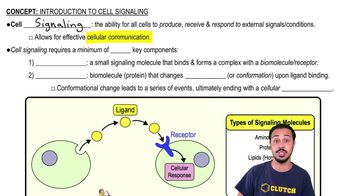
What is the main purpose of cell signaling?
카드를 뒤집기 위해 탭할 수 있습니다.
👆
What is the main purpose of cell signaling?
Cell signaling allows cells to communicate and coordinate their activities in multicellular and unicellular organisms.
진행 상황 추적
컨트롤 버튼이 '내비게이션' 모드로 변경되었습니다.
1/24
추천 영상
05:03
Introduction to Cell Signaling
13636
views
248
rank
2
comments
04:37
3 Steps of Cell Signaling
10193
views
154
rank
이 집합의 용어 (24)
하이드의 정의
What is the main purpose of cell signaling?
Cell signaling allows cells to communicate and coordinate their activities in multicellular and unicellular organisms.
What is paracrine signaling?
A type of local signaling where a cell secretes local regulators that affect nearby target cells, such as growth factors.
What is endocrine signaling?
Long-distance signaling where specialized cells release hormones into the bloodstream to affect distant target cells.
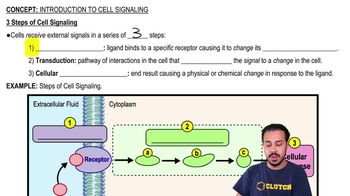
What are the three stages of cell signaling?
Reception
: signal detection;
Transduction
: signal conversion;
Response
: cellular activity triggered by the signal.
What happens during reception in cell signaling?
A signaling molecule (ligand) binds specifically to a receptor, often causing a conformational change that activates the receptor.
Where are signal receptors located?
On the plasma membrane for water-soluble signals or inside the cell (cytoplasm or nucleus) for small, hydrophobic signals.
What is a G protein-coupled receptor (GPCR)?
A plasma membrane receptor that activates a G protein by binding GTP, initiating diverse signaling pathways.
How do ligand-gated ion channels function?
They open or close in response to ligand binding, allowing specific ions to pass and trigger cellular responses.
What is signal transduction?
The process of converting a signal into a cellular response through a cascade of molecular interactions.
What is a phosphorylation cascade?
A series of protein kinases that phosphorylate each other, amplifying the signal and activating proteins in the pathway.
What role do protein phosphatases play?
They remove phosphate groups from proteins, turning off signaling pathways and allowing reuse of kinases.
What are second messengers?
Small, nonprotein molecules like cyclic AMP (cAMP) and Ca2+ that diffuse within the cell to relay signals.
How does cyclic AMP (cAMP) function in signaling?
It is produced from ATP by adenylyl cyclase and activates protein kinase A to phosphorylate target proteins.
What is the cellular response in signaling pathways?
Changes in gene expression or enzyme activity that alter cell behavior or metabolism.
What is activation energy (E_a)?
The energy required to start a chemical reaction by breaking bonds in reactant molecules.
How do enzymes speed up reactions?
By lowering the activation energy barrier without changing the overall free energy change (ΔG).
What is substrate specificity in enzymes?
Enzymes bind only specific substrates at their active sites due to complementary shapes and chemical interactions.
What is induced fit in enzyme activity?
The enzyme changes shape upon substrate binding to enhance interaction and catalysis.
What are cofactors and coenzymes?
Nonprotein helpers required by some enzymes; cofactors can be inorganic or organic, with organic cofactors called coenzymes.
What is competitive inhibition?
An inhibitor binds to the enzyme's active site, blocking substrate binding; can be overcome by increasing substrate concentration.
What is noncompetitive inhibition?
An inhibitor binds to a different site, causing a conformational change that reduces enzyme activity regardless of substrate presence.
What is allosteric regulation?
Regulation of enzyme activity by binding of molecules at sites other than the active site, causing activation or inhibition.
What is cooperativity in enzymes?
Binding of a substrate to one subunit of a multisubunit enzyme increases the activity of other subunits.
What is feedback inhibition?
The end product of a metabolic pathway inhibits an earlier enzyme to prevent overproduction and conserve resources.
 뒤로뒤로
 05:03