 뒤로
General Biology: Cell Structure and Membrane Function
 04:26

이 집합의 용어 (28)
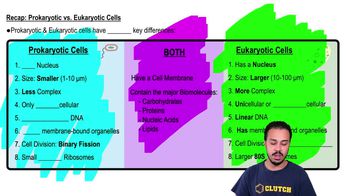
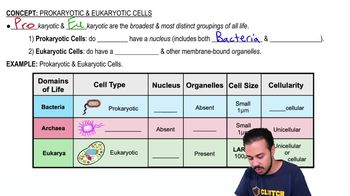
Prokaryotic cells lack membrane-bound organelles and a nucleus; eukaryotic cells have membrane-bound organelles and a nucleus. Both have plasma membranes and ribosomes.
The plasma membrane is a phospholipid bilayer that controls entry and exit of substances. Both prokaryotic and eukaryotic cells have a plasma membrane.
The nucleus contains DNA, controls cell activities, and is surrounded by a double membrane with pores for transport.
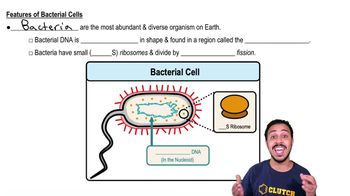
Ribosomes synthesize proteins by translating mRNA; they can be free in cytoplasm or bound to the rough ER.
Includes vesicles, ER (smooth and rough), Golgi apparatus, lysosomes, and vacuoles, which work together to modify, package, and transport proteins and lipids.
Rough ER has ribosomes and synthesizes proteins; smooth ER lacks ribosomes and synthesizes lipids and detoxifies chemicals.
The Golgi apparatus modifies, sorts, and packages proteins and lipids for secretion or delivery to other organelles.
Lysosomes contain digestive enzymes to break down macromolecules and damaged organelles.
Vacuoles store nutrients, waste products, and help maintain turgor pressure in plant cells.
Mitochondria generate ATP via cellular respiration; chloroplasts conduct photosynthesis; peroxisomes detoxify harmful substances.
The cytoskeleton provides cell shape, support, and movement; includes microtubules, microfilaments, and intermediate filaments.
Motor proteins move organelles and vesicles along cytoskeletal tracks using ATP.
Includes cell wall, extracellular matrix, and cell junctions like plasmodesmata, tight junctions, desmosomes, and gap junctions for communication and support.
Phospholipids have hydrophilic heads and hydrophobic tails, forming a bilayer that creates a semi-permeable membrane.
The membrane is a fluid bilayer with embedded proteins, allowing lateral movement and dynamic structure.
Saturated tails make membranes less fluid and more viscous; unsaturated tails increase fluidity by preventing tight packing.
Cholesterol stabilizes membrane fluidity by preventing tight packing in cold and restraining movement in heat.
Integral proteins span the membrane; peripheral proteins attach to surfaces; functions include transport, enzymatic activity, and cell signaling.
Small nonpolar molecules pass easily; large or polar molecules require transport proteins; ions need channels or carriers.
Includes diffusion, osmosis, and facilitated diffusion; moves substances down concentration gradients without energy.
Isotonic: equal solute concentration; hypertonic: higher solute outside, causing cell shrinkage; hypotonic: lower solute outside, causing cell swelling.
Plant cells become turgid in hypotonic, plasmolyzed in hypertonic; animal cells lyse in hypotonic and shrivel in hypertonic solutions.
Water potential predicts water movement; water moves from higher to lower water potential; calculated as \(\Psi = \Psi_s + \Psi_p\).
Uses channel proteins for specific passage and carrier proteins for conformational transport; no energy required.
Active transport moves substances against their concentration gradient, requiring ATP to power transport proteins.
Proton pumps use ATP to move H+ ions across membranes, creating electrochemical gradients.
Cotransport uses the gradient of one molecule to drive the transport of another molecule against its gradient.
Exocytosis exports large molecules via vesicles; endocytosis imports substances by vesicle formation.