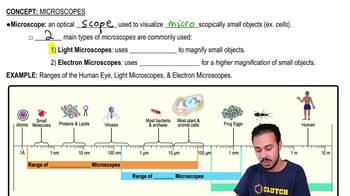
A microscope is an optical instrument used to visualize microscopically small objects such as cells that are too small to be seen by the naked eye.
Name the two main types of microscopes and their light sources.
1) Light microscopes use visible light to magnify small objects. 2) Electron microscopes use electron beams for higher magnification of smaller objects.
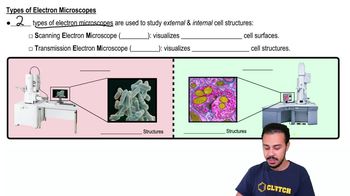
What are the two types of electron microscopes and their uses?
Scanning Electron Microscope (SEM) visualizes cell surfaces. Transmission Electron Microscope (TEM) visualizes internal cell structures.
What distinguishes prokaryotic cells from eukaryotic cells?
Prokaryotic cells lack a nucleus and membrane-bound organelles, while eukaryotic cells have a nucleus and membrane-bound organelles.
Which domains of life are classified as prokaryotes?
Bacteria and Archaea are the two domains classified as prokaryotes.
Where is bacterial DNA located and what is its shape?
Bacterial DNA is circular and found in a region called the nucleoid, which is not membrane-bound.
How do bacteria reproduce and what type of ribosomes do they have?
Bacteria reproduce by binary fission and have small 70S ribosomes.
Describe the DNA and ribosomes in eukaryotic cells.
Eukaryotic DNA is linear and located inside the nucleus. They have larger 80S ribosomes.
What is a key organelle present in eukaryotic cells but absent in prokaryotic cells?
The nucleus is present in eukaryotic cells and packages genetic material, but is absent in prokaryotic cells.
List three features common to all cell types.
All cells contain DNA as genetic material, a protective cell membrane, and a fluid-like portion called the cytoplasm.
What are ribosomes and their function?
Ribosomes are molecular machines that build proteins in all living cells through the process of translation.
Where can ribosomes be found in eukaryotic cells?
Ribosomes can be free-floating in the cytoplasm or attached to the rough endoplasmic reticulum.
What are the components of the cytoskeleton in eukaryotic cells?
The cytoskeleton includes microtubules, microfilaments, and intermediate filaments.
Which two organelles produce cellular energy in eukaryotic cells?
The mitochondria and chloroplasts produce cellular energy.
What is the endomembrane system?
A group of membrane-bound organelles in eukaryotic cells interconnected by transport vesicles, involved in protein secretion and cellular transport.
What is the role of the nucleus in protein secretion?
The nucleus stores DNA, the genetic code for proteins, and is the site where DNA is transcribed into RNA.
Describe the nuclear envelope and its function.
The nuclear envelope is a double membrane surrounding the nucleus, with nuclear pores allowing selective entry and exit.
What is the nucleolus and its function?
The nucleolus is a dense structure inside the nucleus where ribosomal RNA (rRNA) and ribosomes are assembled.
Differentiate between rough and smooth endoplasmic reticulum (ER).
The rough ER has ribosomes on its surface and folds/modifies proteins. The smooth ER lacks ribosomes and synthesizes lipids and detoxifies substances.
Which cell type would have a high concentration of smooth ER?
Cells that make steroid hormones, such as endocrine cells, have a high concentration of smooth ER.
 뒤로
 06:35