 뒤로
General Biology: Cells Topic Flashcards
 06:35

이 집합의 용어 (25)
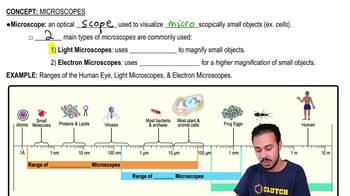
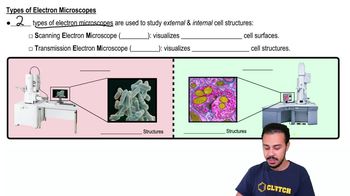
Light microscopes visualize living cells and general structures; electron microscopes (TEM and SEM) visualize detailed ultrastructure at high resolution.
Prokaryotic cells lack a nucleus and membrane-bound organelles; eukaryotic cells have a nucleus and organelles.
Plant cells have a cell wall, chloroplasts, and large central vacuoles; animal cells lack these but have centrioles and lysosomes.
Cells are limited by the surface area to volume ratio, which affects nutrient uptake and waste removal efficiency.
The smooth ER synthesizes lipids, metabolizes carbohydrates, and detoxifies drugs and poisons.
The rough ER has ribosomes and synthesizes proteins destined for secretion or membranes.
The cytoskeleton is made of microtubules, microfilaments, and intermediate filaments, providing structure and transport.
Includes the nuclear envelope, ER, Golgi apparatus, lysosomes, vesicles, and plasma membrane.
The nucleus stores DNA; the nucleolus produces ribosomal RNA; the nuclear envelope controls entry and exit of materials.
The Golgi modifies, sorts, and packages proteins and lipids for secretion or delivery to other organelles.
Lysosomes contain enzymes that digest macromolecules and recycle cellular components.
Vesicles transport materials between organelles and to/from the plasma membrane.
Mitochondria generate ATP through cellular respiration, supplying energy to the cell.
Chloroplasts conduct photosynthesis, converting light energy into chemical energy in plant cells.
Bound ribosomes are attached to the ER and synthesize proteins for membranes or export; free ribosomes float in cytosol and make proteins for the cell.
Flagella and cilia enable cell movement and fluid movement across cell surfaces.
The membrane is composed of a phospholipid bilayer, proteins, cholesterol, and carbohydrates.
The membrane is selectively permeable, fluid, and dynamic, controlling substance entry and exit.
Small nonpolar molecules and gases pass freely; ions and polar molecules require transport proteins.
Includes diffusion, osmosis, and facilitated diffusion, moving substances down their concentration gradient without energy.
Active transport uses energy to move substances against gradients, e.g., the sodium-potassium pump, endocytosis, and exocytosis.
Includes phagocytosis (cell eating), pinocytosis (cell drinking), and receptor-mediated endocytosis.
Hypertonic: solution has higher solute concentration; hypotonic: lower solute; isotonic: equal solute concentration relative to the cell.
ATP stores and transfers energy, powering cellular work like transport and synthesis.
Water potential (\(\Psi\\)) predicts water movement; equation: \(\Psi = \Psi_s + \Psi_p\), where Ψs is solute potential and Ψp is pressure potential.