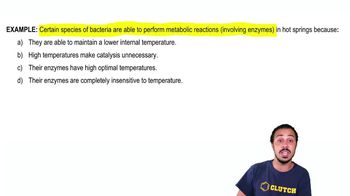
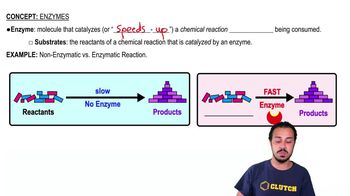
What is the role of enzymes in biological reactions?
Enzymes are proteins that act as biological catalysts, speeding up reactions by lowering the activation energy required.
What determines the specificity of an enzyme for its substrate?
The shape and charge of the substrate must be compatible with the enzyme's active site, forming an enzyme-substrate complex.
How do environmental factors affect enzyme activity?
Changes in temperature, pH, and chemical environment can denature enzymes, altering their shape and reducing activity.
What is enzyme denaturation and is it reversible?
Denaturation is the loss of enzyme's structure and function due to environmental changes. It can be reversible if the primary structure remains intact and conditions normalize.
How do competitive and noncompetitive inhibitors differ?
Competitive inhibitors bind reversibly to the active site, blocking substrate binding. Noncompetitive inhibitors bind to allosteric sites, changing enzyme shape and activity.
What is the structure of ATP and how does it store energy?
ATP consists of adenine, ribose, and three phosphate groups. Energy is stored in the high-energy phosphate bonds and released when ATP is hydrolyzed to ADP + Pi.
What are the two main stages of photosynthesis?
Photosynthesis has two stages: the light reactions (convert light energy to ATP and NADPH) and the Calvin cycle (uses ATP and NADPH to fix CO2 into sugars).
Where do the light reactions and Calvin cycle occur in the chloroplast?
Light reactions occur in the thylakoid membranes (grana), and the Calvin cycle occurs in the stroma of the chloroplast.
What is the function of photosystem II in photosynthesis?
Photosystem II absorbs light at 680 nm, excites electrons, and splits water to replace lost electrons, releasing O2 and pumping H+ to create a gradient.
How is ATP synthesized during photosynthesis?
ATP is produced by chemiosmosis, where H+ ions flow down their gradient through ATP synthase, driving phosphorylation of ADP to ATP.
What enzyme catalyzes the first step of the Calvin cycle?
The enzyme rubisco catalyzes the fixation of CO2 to RuBP, initiating the Calvin cycle.
What are the three phases of the Calvin cycle?
The Calvin cycle phases are: 1) Carbon fixation, 2) Reduction of 3-PGA to G3P, and 3) Regeneration of RuBP.
What is photorespiration and why is it problematic for C3 plants?
Photorespiration occurs when rubisco binds O2 instead of CO2, wasting ATP and reducing sugar production, especially under hot, dry conditions.
How do C4 and CAM plants adapt to reduce photorespiration?
C4 plants spatially separate carbon fixation and Calvin cycle; CAM plants temporally separate these processes by fixing CO2 at night to conserve water.
What is the overall equation for cellular respiration?
 뒤로
 02:32