 뒤로
General Biology: Cellular Reactions and Enzymes
 04:18

이 집합의 용어 (20)
ΔG is the change in free energy, calculated as \(G_{products} - G_{reactants}\). It indicates if a reaction is spontaneous (negative ΔG) or not (positive ΔG).
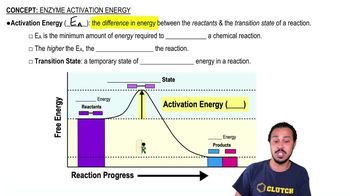
Activation energy (EA) is the energy barrier that must be overcome for a reaction to proceed. It is represented as the height of the hump on an energy diagram.
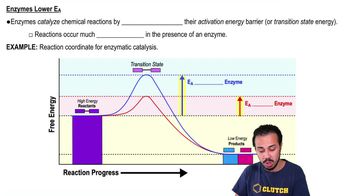
Enzymes lower the activation energy (EA), speeding up reactions, but they do not change ΔG or the spontaneity of the reaction.
A negative ΔG means the reaction is exergonic and spontaneous, releasing free energy.
A positive ΔG means the reaction is endergonic and non-spontaneous, requiring energy input.
The left plateau represents the reactants' free energy, and the right plateau represents the products' free energy.
In an exergonic reaction, the products have lower free energy than reactants, so the right plateau is below the left, and ΔG is negative.
In an endergonic reaction, the products have higher free energy than reactants, so the right plateau is above the left, and ΔG is positive.
An enzyme lowers the height of the activation energy hump, making the reaction proceed faster.
No, enzymes do not change ΔG; the start and end energy levels remain the same.
No, enzymes cannot change the spontaneity of a reaction; they only affect the rate by lowering activation energy.
A spontaneous reaction occurs without energy input and has a negative ΔG.
Exergonic reactions release free energy and have a negative ΔG.
Endergonic reactions absorb free energy and have a positive ΔG.
Activation energy is the initial energy needed to start a reaction, so even spontaneous reactions may be slow without overcoming this barrier.
The horizontal axis represents the progress of the reaction over time.
The vertical axis represents the free energy of the system.
By lowering activation energy, enzymes increase the reaction rate, allowing products to form faster.
The energy hump represents the activation energy barrier that must be overcome for the reaction to proceed.
The energy levels of reactants and products remain unchanged; only the activation energy barrier is lowered.