 뒤로
General Biology Chapter 1 & 2 Study Guide Flashcards
 09:26

이 집합의 용어 (36)
Biology is the scientific study of life.
Emergent properties are new properties that arise from the arrangement and interaction of parts within a system at each level of biological organization.
From smallest to largest: molecules, organelles, cells, tissues, organs, organ systems, organisms, populations, communities, ecosystems, biosphere.
Population is members of the same species in an area; community includes all living organisms of different species in an area.
Community includes all living organisms; ecosystem includes living organisms plus nonliving factors in an area.
All cells have a membrane and contain DNA. They perform all activities required for life.
Prokaryotic cells lack a nucleus and membrane-bound organelles; eukaryotic cells have a nucleus and membrane-bound organelles.
Bacteria, Archaea, and Eukarya.
Bacteria and Archaea have prokaryotic cells.
Protists, Fungi, Plantae, and Animalia.
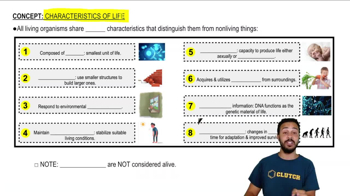
Composed of cells, use DNA as genetic material, share similar cell structure and function, and have a universal genetic code.
The genetic code is shared by all organisms, indicating common ancestry.
Evolution is descent with modification, meaning populations change over time.
Process where individuals with advantageous traits survive and reproduce more, leading to adaptation in populations.
Because more offspring are produced than can survive due to limited resources.
No, only populations evolve over generations through changes in allele frequencies.
Inherited traits that increase an organism's fitness in its environment.
Observation, hypothesis formation, prediction, experimentation, analysis, and conclusion.
A testable and falsifiable proposed explanation for a set of observations.
A hypothesis is a tentative explanation; a theory is broader, well-supported, and can generate new hypotheses.
An experiment comparing a control group and an experimental group differing in only one factor (independent variable).
The variable that is changed or tested in an experiment; placed on the x-axis of a graph.
The variable measured in an experiment; placed on the y-axis of a graph.
Variables kept constant between control and experimental groups to ensure a fair test.
To provide a baseline for comparison to the experimental group.
Anything that has mass and occupies space.
A substance that cannot be broken down into other substances by chemical reactions.
Carbon, Hydrogen, Nitrogen, Oxygen, Phosphorus, Sulfur.
Protons (+), Neutrons (0), Electrons (-).
Atomic number = number of protons; Atomic mass = protons + neutrons.
Atoms of the same element with different numbers of neutrons.
Bond formed by attraction between oppositely charged ions.
Bond formed by sharing of electron pairs between atoms.
Polar bonds share electrons unequally; nonpolar bonds share electrons equally.
Ability of an atom to attract electrons in a chemical bond.
Weak attraction between a slightly positive hydrogen atom and a slightly negative atom.