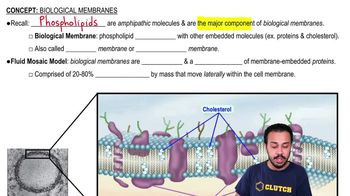
What is the primary function of biological membranes?
Biological membranes regulate the passage of substances in and out of cells and organelles, maintaining homeostasis.
What are the main components of a cell membrane?
Cell membranes are mainly composed of a phospholipid bilayer, proteins, cholesterol, and carbohydrates.
Describe the structure of the phospholipid bilayer.
The bilayer consists of hydrophilic phosphate heads facing outward and hydrophobic fatty acid tails facing inward.
What role do membrane proteins play?
Membrane proteins assist in transport, signal transduction, cell recognition, and structural support.
How does cholesterol affect membrane fluidity?
Cholesterol stabilizes membrane fluidity by preventing tight packing of phospholipids at low temperatures and restraining movement at high temperatures.
What is selective permeability in membranes?
Selective permeability allows membranes to control which molecules enter or exit the cell based on size, charge, and solubility.
Define passive transport across membranes.
Passive transport is the movement of molecules down their concentration gradient without energy input.
What is diffusion?
Diffusion is the passive movement of molecules from an area of higher concentration to lower concentration.
Explain osmosis.
Osmosis is the diffusion of water across a selectively permeable membrane toward a higher solute concentration.
What is facilitated diffusion?
Facilitated diffusion uses membrane proteins to help specific molecules cross the membrane down their concentration gradient.
Describe active transport.
Active transport moves molecules against their concentration gradient using energy, often from ATP.
What is the sodium-potassium pump?
A membrane protein that uses ATP to pump 3 sodium ions out and 2 potassium ions into the cell, maintaining electrochemical gradients.
What are the two main types of membrane proteins?
Integral proteins, which span the membrane, and peripheral proteins, which are attached to the membrane surface.
How do membranes contribute to cell signaling?
Membranes contain receptor proteins that detect signals and initiate cellular responses.
What is endocytosis?
Endocytosis is the process by which cells engulf external substances by folding the membrane inward.
Define exocytosis.
Exocytosis is the process of vesicles fusing with the membrane to release contents outside the cell.
What is the fluid mosaic model?
A model describing membranes as a fluid phospholipid bilayer with proteins embedded, moving laterally.
How do temperature changes affect membrane fluidity?
 뒤로
 02:21