 뒤로
General Biology: Diversity of Fungi and Animals

 08:59

이 집합의 용어 (26)
Fungi are heterotrophic, use absorptive nutrition, are sessile, usually multicellular, have cell walls made of chitin, and bodies made of mycelium.
Both fungi and animals belong to Opisthokonta and share traits like heterotrophy and certain molecular features.
Fungi alternate between haploid and diploid stages, with most of the life cycle spent in the haploid phase.
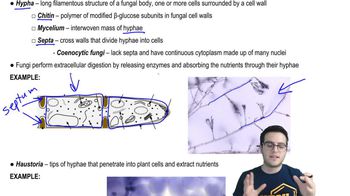
Fungi bodies consist of hyphae forming a mycelium; growth occurs at hyphal tips responsible for nutrient absorption and reproduction.
Fungi act as decomposers, form mycorrhizal associations, act as pathogens, form lichens with algae, and have biotechnological applications.
Fungi grow by extending their hyphal tips through localized cell wall synthesis and cytoplasmic expansion.
Hyphae: fungal filaments; mycelium: network of hyphae; yeast: unicellular fungi; mycorrhizae: symbiotic fungi-root associations.
Animals are heterotrophic, multicellular, lack cell walls, usually have nerves and muscles, and can move.
The Cambrian Period saw a rapid increase in animal diversity due to new ecological niches and evolutionary innovations.
Bilateral symmetry allows for directional movement and more active lifestyles in animals.
Diploblastic animals have two germ layers (ectoderm, endoderm); triploblastic have three (ectoderm, mesoderm, endoderm).
Animals mostly reproduce sexually with a gametic life cycle, where gametes are the only haploid stage.
Protostomes: blastopore becomes mouth; deuterostomes: blastopore becomes anus; differ in cleavage and coelom formation.
Tissue: group of similar cells; bilateral symmetry: single plane divides body into mirror halves; radial symmetry: multiple planes.
Animal groups evolved key traits like tissues, bilateral symmetry, protostome/deuterostome development, ecdysis, and lophotrochozoan features.
Porifera: sponges, filter feeders with choanocytes; Cnidaria: radial symmetry, cnidocytes, polyp and medusa forms.
Choanocyte: collar cell in sponges; amoebocyte: mobile cell; polyp: sessile cnidarian form; medusa: free-swimming form.
Vertebrates include jawless fishes, gnathostomes, amphibians, amniotes, mammals, with adaptations like jaws, lungs, limbs, amniotic egg, and hair.
Tetrapods evolved structural support, new locomotion methods, and air-breathing adaptations to live on land.
Amniotes have amniotic eggs, internal fertilization, desiccation-resistant skin, and thoracic breathing to thrive on land.
Turtles, lepidosaurs, crocodilians, and birds have distinct traits adapted to their environments and lifestyles.
Monotremes lay eggs; marsupials have pouches; eutherians have complex placentas and longer development.
Primates have grasping hands and large brains; groups include anthropoids, monkeys, apes, humans, chimpanzees, and gorillas.
Humans evolved bipedalism; genera Australopithecus and Homo show key traits; multiple Homo species overlapped in time and originated in Africa.
Chordates have a notochord, pharyngeal slits, dorsal nerve cord, post-anal tail; groups include cephalochordates, urochordates, and vertebrates.
Notochord: flexible rod; pharyngeal slits: openings in throat; amniotic egg: egg with protective membranes for land reproduction.