뒤로

General Biology: DNA Cloning and Replication

컨트롤 버튼이 '내비게이션' 모드로 변경되었습니다.
1/20
  • What is the purpose of a cloning vector in gene cloning?

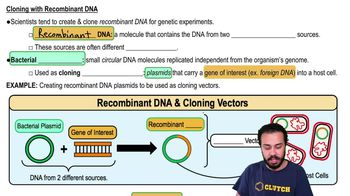
    A cloning vector is a small, circular DNA molecule (like a plasmid) used to insert and replicate a gene of interest in bacteria, which cannot replicate linear DNA.
  • Name the three essential components of a cloning vector.

    • Origin of replication (for DNA replication in bacteria)
    • Multiple cloning site (MCS) within a marker gene like lacZ
    • Selectable marker gene (e.g., antibiotic resistance such as AmpR)
  • Why is the lacZ gene used in cloning vectors?

    The lacZ gene encodes beta-galactosidase, which can be used for blue-white screening to identify colonies with or without the inserted gene.
  • What is the role of restriction enzymes in cloning?

    Restriction enzymes cut DNA at specific palindromic sequences, allowing insertion of a gene into a vector at matching sites.
  • What are sticky ends and why are they important in cloning?

    Sticky ends are single-stranded overhangs created by restriction enzymes that facilitate the ligation of DNA fragments with complementary sequences.
  • How does DNA ligase function in the cloning process?

    DNA ligase seals the sugar-phosphate backbone by forming phosphodiester bonds, joining DNA fragments together.
  • Why treat the vector with phosphatase before ligation?

    Phosphatase removes 5' phosphate groups from the vector to prevent it from self-ligating without the insert.
  • What is blue-white screening and how does it work?

    Blue-white screening uses X-gal substrate; colonies with intact lacZ produce blue color, while those with an inserted gene disrupting lacZ remain white.
  • How do you confirm that a plasmid contains the inserted gene after cloning?

    Use restriction enzyme digestion (e.g., HindIII) and gel electrophoresis to check for expected fragment sizes indicating the insert's presence.
  • What is transformation in molecular cloning?

    Transformation is the process of introducing recombinant plasmid DNA into bacterial cells to propagate the cloned gene.
  • Why is ampicillin added to bacterial growth media after transformation?

    Ampicillin selects for bacteria that have taken up the plasmid containing the AmpR resistance gene, killing those without it.
  • What is the central dogma of molecular biology relevant to insulin production?

    DNA (insulin gene) is transcribed into mRNA, which is then translated into insulin protein.
  • Why can't bacteria perform all post-transcriptional modifications of human insulin?

    Bacteria lack the machinery for RNA processing, protein folding, and secretion pathways present in human cells.
  • What techniques can verify the production of insulin protein in bacteria?

    Western blot and ELISA can detect and confirm the presence of specific insulin protein.
  • What is a palindromic sequence in DNA?

    A palindromic sequence reads the same 5' to 3' on both strands, important as recognition sites for restriction enzymes.
  • What type of ends does HindIII produce when it cuts DNA?

    HindIII produces 5' sticky ends with overhanging single-stranded DNA.
  • Why is it important to use the same restriction enzyme on both the vector and the insert?

    Using the same enzyme creates compatible sticky ends that can anneal and be ligated efficiently.
  • What is the function of the origin of replication in a plasmid?

    It allows the plasmid to be replicated independently within the bacterial cell.
  • What is the significance of the multiple cloning site (MCS)?

    The MCS contains multiple unique restriction sites to facilitate insertion of foreign DNA.
  • How does the immune system cause Type I diabetes?

    The immune system attacks pancreatic beta cells, preventing glucose from entering cells.