 뒤로
General Biology: DNA Structure, Function, and Protein Synthesis
 05:45

이 집합의 용어 (22)
mRNA carries the genetic code from DNA in the nucleus to the ribosome, where it directs the sequence of amino acids in a protein.
tRNA transfers specific amino acids to the ribosome and matches its anticodon with codons on the mRNA to ensure correct protein assembly.
rRNA is a structural and catalytic component of ribosomes, facilitating the assembly of amino acids into protein chains.
A codon is a sequence of three nucleotides on mRNA that specifies a particular amino acid or a stop signal during translation.
An anticodon is a set of three nucleotides on tRNA complementary to an mRNA codon, ensuring the correct amino acid is added to the growing protein.
The start codon (usually AUG) signals the beginning of translation and codes for the amino acid methionine.
Stop codons (UAA, UAG, UGA) signal the termination of translation, releasing the completed polypeptide chain.
Translation involves initiation (ribosome assembly at start codon), elongation (amino acid chain growth), and termination (release at stop codon).
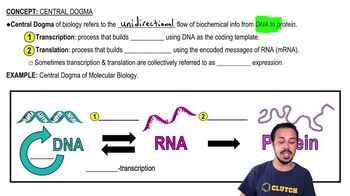
Transcription copies DNA into mRNA in the nucleus; translation uses mRNA to synthesize proteins at the ribosome.
DNA replication is the process of copying the DNA molecule to produce two identical DNA strands before cell division.
DNA contains deoxyribose sugar and thymine; RNA contains ribose sugar and uracil instead of thymine.
The sugar-phosphate backbone forms the structural framework of DNA and RNA strands, linking nucleotides together.
Exons are coding sequences in RNA that remain after splicing; introns are non-coding sequences removed during RNA processing.
RNA splicing removes introns from pre-mRNA, joining exons to form mature mRNA ready for translation.
A mutation is a change in the DNA sequence that can affect protein function and organism traits.
Insertion adds nucleotides, deletion removes nucleotides, and substitution replaces one nucleotide with another.
Mutagens are physical or chemical agents that increase the rate of mutations in DNA.
Mutations can disrupt protein function causing disease or provide genetic variation that may improve survival.
The genetic code is the set of rules by which nucleotide triplets (codons) specify amino acids in proteins.
RNA polymerase synthesizes RNA by reading the DNA template strand during transcription.
A promoter is a DNA sequence where RNA polymerase binds to initiate transcription.
A terminator is a DNA sequence signaling RNA polymerase to stop transcription.