Skip to main content
General Biology
나의 코스
배우기
시험 준비
AI 튜터
학습 가이드
교과서적 해결책
플래시카드
탐험해 보세요
앱을 사용해 보세요
나의 코스
배우기
시험 준비
AI 튜터
학습 가이드
교과서적 해결책
플래시카드
탐험해 보세요
앱을 사용해 보세요
뒤로
General Biology - Energy and Enzymes
카드를 뒤집기 위해 탭할 수 있습니다.
What is energy?
카드를 뒤집기 위해 탭할 수 있습니다.
👆
What is energy?
Energy
is the capacity to cause change or perform work.
진행 상황 추적
컨트롤 버튼이 '내비게이션' 모드로 변경되었습니다.
1/21
추천 영상
02:17
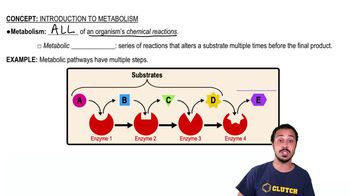
Introduction to Metabolism
22399
views
414
rank
03:25
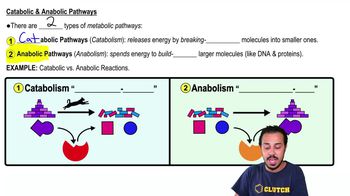
Catabolic & Anabolic Pathways
20896
views
358
rank
2
comments
이 집합의 용어 (21)
하이드의 정의
What is energy?
Energy
is the capacity to cause change or perform work.
What are the two main types of energy?
Kinetic energy
is energy of motion, such as heat.
Potential energy
is energy possessed due to location or structure, like chemical energy.
What does the 1st Law of Thermodynamics state?
Energy can neither be created nor destroyed; it can only change forms.
What does the 2nd Law of Thermodynamics state?
Every energy transfer increases the entropy (disorder) of the universe, and most energy is eventually lost as heat.
Define metabolism.
The totality of an organism's chemical reactions, including catabolism and anabolism.
What is an exergonic reaction?
A chemical reaction that releases energy; reactants have higher energy than products.
What is an endergonic reaction?
A chemical reaction that requires energy input; products have higher energy than reactants.
What is ATP and its role?
ATP (adenosine triphosphate)
is the molecule that transports energy in the cell and powers most cellular work.
What happens during ATP hydrolysis?
ATP is broken down by hydrolysis into ADP and phosphate, releasing energy.
What is energy coupling?
The use of energy released from exergonic reactions to drive endergonic reactions, often via ATP phosphorylation.
What is activation energy?
The energy barrier that must be overcome for a chemical reaction to begin.
What is a substrate in enzymatic reactions?
The reactant molecule that an enzyme acts upon.
What is the active site of an enzyme?
The specific region where the substrate binds and the reaction occurs.
What is induced fit in enzyme activity?
A change in enzyme shape that enhances binding to the substrate and catalysis.
How do temperature and pH affect enzyme activity?
Enzymes have optimal temperature and pH ranges; deviations can reduce activity or denature the enzyme.
What are cofactors and coenzymes?
Non-protein helpers required for enzyme activity; cofactors are inorganic, coenzymes are organic molecules.
What is competitive inhibition?
An inhibitor binds to the enzyme's active site, blocking substrate binding.
What is noncompetitive inhibition?
An inhibitor binds elsewhere on the enzyme, changing its shape and reducing activity.
What is allosteric regulation?
Regulation of enzyme activity by binding of activators or inhibitors at sites other than the active site.
What is feedback inhibition?
The end product of a metabolic pathway binds allosterically to an enzyme early in the pathway to halt its own synthesis.
How does glyphosate (Roundup) inhibit plant enzymes?
Glyphosate competitively inhibits EPSPS, an enzyme needed for aromatic amino acid synthesis, killing weeds but not Roundup-resistant crops.
 뒤로뒤로
 02:17