 뒤로
General Biology: Energy and Life
 04:21

이 집합의 용어 (23)
Energy is the capacity to do work.
Work is force multiplied by distance moved.
Kinetic energy is energy of motion; potential energy is energy due to an object's location or structure.
Energy can be converted from one form to another but cannot be created or destroyed.
Entropy is the amount of disorder in a system.
To capture sunlight and store it as chemical energy in sugar; oxygen is released as a by-product.
Light reactions occur in the thylakoid membranes; Calvin cycle occurs in the stroma.
Oxygen comes from water split during the light reactions.
ATP shuttles energy; NADPH shuttles high-energy electrons to the Calvin cycle.
The Calvin cycle produces G3P, a three-carbon sugar used to generate glucose.
Yes, both producers and consumers use cellular respiration to release energy from food and make ATP.
Glycolysis in the cytoplasm; citric acid cycle in the mitochondrial matrix; electron transport chain in the inner mitochondrial membrane.
The electron transport chain produces the most ATP.
Photosynthesis uses CO\(2\) and water plus light to make sugar and oxygen; respiration uses sugar and oxygen to produce CO\(2\), water, and ATP.
Fermentation is an anaerobic process that harvests some energy from glucose without oxygen.
Lactic acid fermentation occurs in animal muscle cells when oxygen is low; alcohol fermentation by yeast produces ethanol and CO\(2\).
Metabolism is the sum of all chemical reactions in the body.
Carbohydrates, fats, and proteins can all supply energy for ATP production.
ATP is a common cellular energy-currency molecule that supplies energy to drive cellular processes.
6 CO\(2\) + 6 H\(2\)O + light energy → CH12O\(6\) + 6 O\(2\)
CH12O\(6\) + 6 O\(2\) → 6 CO\(2\) + 6 H\(2\)O + energy (ATP)
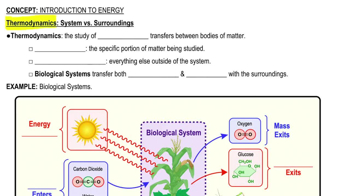
Sunlight → photosynthesis → sugars → cellular respiration → ATP → cellular work.
Chlorophyll absorbs blue/violet and orange/red light and reflects green/yellow light, making plants appear green.