 뒤로
General Biology: Energy and Life
 04:21

이 집합의 용어 (38)
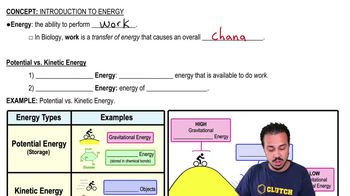
Energy is the ability to perform work, which in biology means causing an overall change or transfer of energy.
Potential energy is stored energy available to do work, while kinetic energy is the energy of motion.
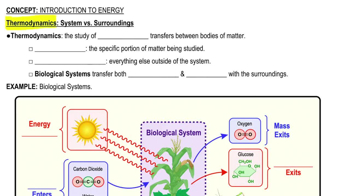
A system is the specific portion of matter being studied, and the surroundings are everything else outside the system. Biological systems transfer both energy and matter with their surroundings.
Energy cannot be created or destroyed, only transferred or transformed. The total energy in the universe remains constant.
Entropy measures disorder or randomness; higher disorder means higher entropy. Natural reactions tend to increase the universe's entropy.
Energy conversions are never 100% efficient; some energy is lost as heat, increasing the entropy of the universe.
Reactants are the starting materials, and products are the resulting materials after a chemical reaction.
Endergonic reactions require energy input, while exergonic reactions release energy.
Adenosine Triphosphate (ATP) is an energy molecule composed of a chain of three phosphate groups, a ribose sugar, and an adenine nitrogenous base.
Breaking the bond between phosphate groups releases energy and converts ATP to ADP or AMP.
Energy released by ATP hydrolysis powers endergonic reactions by providing the necessary energy input.
Phosphorylation is the transfer of a phosphate group from ATP to another molecule, which can activate the molecule or change its shape.
An enzyme is a molecule that catalyzes a chemical reaction without being consumed, speeding up the reaction.
Enzymes build molecules, copy DNA, and break down food.
Temperature, pH, and substrate concentration affect enzyme activity. Extreme conditions can denature enzymes, reducing their function.
Activation energy is the minimum energy required to start a chemical reaction by reaching the transition state.
Enzymes lower the activation energy barrier, allowing reactions to proceed faster.
A substrate binds to an enzyme's active site forming the enzyme-substrate complex, after which products are released and the enzyme remains unchanged.
Cofactors are non-protein substances (like metal ions) required for enzyme activity; coenzymes are organic cofactors derived from vitamins.
Competitive inhibitors bind the active site competing with the substrate; noncompetitive inhibitors bind an allosteric site, changing the enzyme's shape.
Metabolism is the sum of all chemical reactions in an organism, including metabolic pathways that alter substrates through multiple steps.
Catabolic pathways break down molecules releasing energy; anabolic pathways build molecules consuming energy.
Feedback inhibition occurs when the final product of a metabolic pathway inhibits an earlier step, regulating the pathway.
Redox reactions transfer electrons; oxidation is loss of electrons, reduction is gain of electrons, and they always occur together.
NADH and FADH2 are electron carriers that shuttle electrons to the electron transport chain during cellular respiration.
Aerobic cellular respiration breaks down glucose in the presence of oxygen to produce ATP, CO2, and water.
Glycolysis, pyruvate oxidation, Krebs cycle, and electron transport chain with chemiosmosis.
Substrate-level phosphorylation directly transfers phosphate to ADP; oxidative phosphorylation uses energy from electron transport to generate ATP.
Glycolysis is the first step of cellular respiration, breaking glucose into two pyruvate molecules in the cytoplasm without oxygen.
Pyruvate is converted to acetyl-CoA in the mitochondrial matrix, producing NADH and CO2.
The Krebs cycle oxidizes acetyl-CoA to produce ATP, NADH, FADH2, and CO2 in the mitochondrial matrix.
ETC harnesses energy from electrons in NADH and FADH2 to pump H+ ions, creating a gradient used to produce ATP.
Diffusion of H+ ions down their concentration gradient through ATP synthase to generate ATP.
Fermentation regenerates NAD+ by reducing pyruvate in the absence of oxygen, allowing glycolysis to continue.
Photosynthesis uses sunlight, CO2, and water to produce glucose and oxygen in chloroplasts.
Light reactions convert light energy to ATP and NADPH; Calvin cycle uses these to fix CO2 into glucose.
Photorespiration occurs when Rubisco fixes O2 instead of CO2, wasting energy and reducing photosynthesis efficiency.
C4 and CAM plants minimize photorespiration by spatial or temporal separation of carbon fixation and Calvin cycle.