 뒤로
General Biology: Evolution and Species Concepts
 07:48


이 집합의 용어 (20)
The biological species concept defines species as populations that are reproductively isolated, meaning they do not interbreed or produce viable, fertile offspring.
Pre-zygotic isolation prevents mating or fertilization between species. Post-zygotic isolation occurs when hybrid offspring are produced but have low fitness or are sterile.
Donkeys and horses can mate to produce mules, which are sterile. This is an example of post-zygotic isolation.
The morphological species concept identifies species based on consistent morphological differences that indicate reproductive isolation.
The phylogenetic species concept defines species as the smallest monophyletic groups on a phylogenetic tree, including an ancestor and all its descendants.
Gene flow is the movement of alleles between populations, which can homogenize populations or, if low, allow genetic divergence and speciation.
Genetic drift is random changes in allele frequencies, most significant in small populations, leading to loss or fixation of alleles.
1. Natural selection
2. Genetic drift
3. Gene flow
4. Mutation
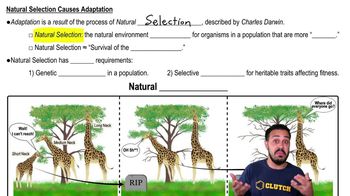
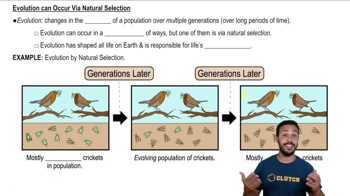
Natural selection can maintain, increase, or reduce genetic variation and generally increases average fitness by producing adaptations.
Mutation introduces new alleles, increasing genetic variation. It is random with respect to fitness and can be deleterious, neutral, or beneficial.
Stabilizing selection favors intermediate trait values, reducing variation and selecting against extremes.
Directional selection favors one extreme of a trait, shifting the population's trait distribution in that direction.
Disruptive selection favors both extremes of a trait, potentially leading to two distinct phenotypes.
Reproductive isolation is caused by pre-zygotic barriers (e.g., temporal, habitat, behavioral, mechanical, gametic) and post-zygotic barriers (e.g., hybrid inviability, sterility).
Species pollinated by different animals (e.g., hummingbirds vs. bees) may not interbreed due to behavioral isolation, a form of pre-zygotic isolation.
The founder effect occurs when a new population is established by a small number of individuals, causing genetic drift and reduced genetic variation.
A population bottleneck is a sharp reduction in population size that reduces genetic variation due to genetic drift.
Gene flow can increase genetic variation in recipient populations by introducing new alleles and decrease it in donor populations.
No, mutations can be deleterious, neutral, or beneficial. Most mutations are neutral or deleterious; beneficial mutations are rare.
An adaptation is a heritable trait that increases an individual's fitness compared to others without the trait.