Skip to main content
General Biology
나의 코스
배우기
시험 준비
AI 튜터
학습 가이드
교과서적 해결책
플래시카드
탐험해 보세요
앱을 사용해 보세요
나의 코스
배우기
시험 준비
AI 튜터
학습 가이드
교과서적 해결책
플래시카드
탐험해 보세요
앱을 사용해 보세요
뒤로
General Biology: Evolution, Fossils, and Molecular Genetics
카드를 뒤집기 위해 탭할 수 있습니다.
What is phylogeny in biology?
카드를 뒤집기 위해 탭할 수 있습니다.
👆
What is phylogeny in biology?
Phylogeny
is the evolutionary history and relationships among organisms.
진행 상황 추적
컨트롤 버튼이 '내비게이션' 모드로 변경되었습니다.
1/21
추천 영상
02:32
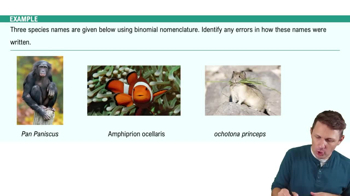
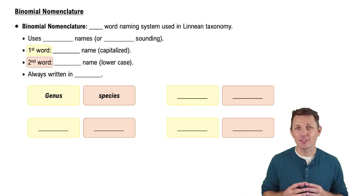
Binomial Nomenclature
3314
views
46
rank
06:57
Systematics
4062
views
84
rank
01:31
Introduction to Phylogeny Example 1
2827
views
33
rank
이 집합의 용어 (21)
하이드의 정의
What is phylogeny in biology?
Phylogeny
is the evolutionary history and relationships among organisms.
Define monophyletic group.
A
monophyletic group
includes a common ancestor and all its descendants.
What distinguishes paraphyletic and polyphyletic groups?
Paraphyletic groups
include some but not all descendants of a common ancestor;
polyphyletic groups
include organisms from different ancestors.
List the Linnaean hierarchy from broadest to most specific.
Kingdom, Phylum, Class, Order, Family, Genus, Species.
How do fossils form?
Fossils form when organisms are buried in sediment that solidifies into sedimentary rock, preserving remains.
What is stratigraphy?
The study of rock layers (strata) and their fossil content.
Explain relative dating in fossils.
Fossils in lower strata are older than those in upper strata.
What is radiometric dating?
A method to assign absolute ages to rocks and fossils by measuring radioactive isotope decay.
Define half-life in radioactive decay.
The time required for half of a radioactive isotope to decay.
What isotopes are used for dating fossils?
Carbon-14 for up to ~50,000 years; potassium-40 and uranium-238 for older samples.
Write the formula for calculating the age of a sample using radioactive decay.
Age \(t\) is calculated by \(t=\frac{\ln(N_0/N)}{\lambda}\), where
λ
is decay constant,
N₀
initial amount, and
N
remaining amount.
List major events in the history of life on Earth.
Origin of life (~3.5-4 bya), photosynthesis (~2.7 bya), eukaryotes (~1.8 bya), multicellularity (~1.2 bya), Cambrian explosion (~535-525 mya), land colonization (~450 mya).
What are the four key steps in the origin of life?
1. Abiotic synthesis of organic compounds, 2. Abiotic synthesis of macromolecules, 3. Formation of protocells, 4. Formation of self-replicating RNA molecules.
What caused the oxygen revolution and its effects?
Photosynthesis in prokaryotes increased atmospheric oxygen (~2.4 bya), causing extinction of anaerobes and evolution of aerobic metabolism.
How did eukaryotic cells originate?
Through serial endosymbiosis where prokaryotes were engulfed, forming organelles like mitochondria and plastids.
What is microevolution?
Evolutionary changes within populations or species over short time scales.
Define macroevolution.
Large-scale evolutionary patterns and processes over long time scales, including origin of major groups and mass extinctions.
What is plate tectonics?
Movement of Earth's lithospheric plates altering continents, oceans, climate, and sea levels.
What was Pangaea?
A supercontinent formed by the collision of Earth's landmasses.
Describe the genetic basis of the pigeon head crest mutation.
A single nucleotide mutation (G to T) in the EphB2 gene causes an amino acid change (arginine to cysteine) reversing feather polarity on the head.
What is the function of the EphB2 protein?
A trans-membrane protein involved in cell signaling and development, especially in the nervous system.
 뒤로뒤로
 02:32