Skip to main content
General Biology
나의 코스
배우기
시험 준비
AI 튜터
학습 가이드
교과서적 해결책
플래시카드
탐험해 보세요
앱을 사용해 보세요
나의 코스
배우기
시험 준비
AI 튜터
학습 가이드
교과서적 해결책
플래시카드
탐험해 보세요
앱을 사용해 보세요
뒤로
General Biology: Evolution, Phylogeny, Prokaryotes, and Eukaryotes
카드를 뒤집기 위해 탭할 수 있습니다.
Abiotic synthesis
카드를 뒤집기 위해 탭할 수 있습니다.
👆
Abiotic synthesis
The formation of organic molecules from inorganic precursors without biological activity, a key step in the origin of life.
진행 상황 추적
컨트롤 버튼이 '내비게이션' 모드로 변경되었습니다.
1/29
추천 영상
03:23
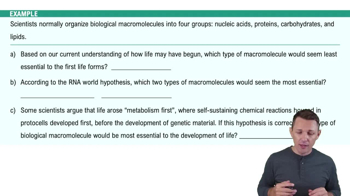
Origin of Life Example 1
2916
views
26
rank
06:38
Events that Lead to the Formation of Cells
3609
views
52
rank
1
comments
이 집합의 용어 (29)
하이드의 정의
Abiotic synthesis
The formation of organic molecules from inorganic precursors without biological activity, a key step in the origin of life.
RNA world hypothesis
The idea that early life used RNA both to store genetic information and to catalyze chemical reactions before DNA and proteins evolved.
Protocell
A simple, cell-like structure with a membrane that exhibits some characteristics of life, such as maintaining an internal environment.
Radiometric dating
A method to determine the age of fossils by measuring the decay of radioactive isotopes and calculating based on half-life.
Endosymbiosis
A theory that explains the origin of eukaryotic cells as a result of one prokaryote living inside another, leading to organelles like mitochondria.
Mass extinction
A widespread and rapid decrease in biodiversity caused by catastrophic events, distinct from background extinction.
Adaptive radiation
The rapid evolution of many species from a common ancestor when new ecological niches become available.
Heterochrony
An evolutionary change in the timing or rate of developmental events, affecting organism morphology.
Phylogenetic tree
A diagram showing evolutionary relationships among species based on common ancestry.
Homology
Similarity in traits due to shared ancestry.
Analogy
Similarity in traits due to convergent evolution, not common ancestry.
Clade
A group of organisms that includes an ancestor and all its descendants, representing a monophyletic group.
Maximum parsimony
A principle that the simplest phylogenetic tree with the fewest evolutionary changes is preferred.
Prokaryote
A unicellular organism lacking a nucleus and membrane-bound organelles, including bacteria and archaea.
Gram-positive bacteria
Bacteria with thick peptidoglycan cell walls that retain the crystal violet stain in Gram staining.
Endospore
A resistant, dormant structure formed by some bacteria to survive harsh conditions.
Binary fission
A form of asexual reproduction in prokaryotes where one cell divides into two genetically identical cells.
Horizontal gene transfer
The movement of genetic material between organisms other than by descent, increasing genetic diversity.
Obligate anaerobe
An organism that cannot survive in the presence of oxygen.
Endosymbiotic theory evidence
Mitochondria and chloroplasts have their own DNA, double membranes, and reproduce independently, supporting their origin from prokaryotes.
Excavata
A eukaryotic supergroup including protists like Giardia and Euglena, characterized by modified mitochondria and unique flagella.
SAR supergroup
A diverse eukaryotic clade including Stramenopiles, Alveolates, and Rhizarians, important in aquatic ecosystems.
Diatoms
Photosynthetic stramenopiles with silica cell walls that contribute significantly to global carbon fixation.
Dinoflagellates
Alveolates with two flagella causing spinning movement; some cause harmful red tides.
Archaeplastida
A eukaryotic supergroup including red algae, green algae, and land plants, characterized by primary plastids.
Amorpheans
A eukaryotic supergroup including amoebozoans and opisthokonts, distinguished by unique pseudopodia or flagella.
Convergent evolution
The independent evolution of similar traits in unrelated lineages due to similar environmental pressures.
Mutualism
A symbiotic relationship where both species benefit.
Paedomorphosis
An evolutionary process where adults retain juvenile features of their ancestors.
 뒤로뒤로
 03:23