 뒤로
General Biology: Evolution, Taxonomy, and Natural Selection
 07:48

이 집합의 용어 (26)
Taxonomy is the branch of biology concerned with identifying, naming, and classifying species.
Carl Linnaeus is the father of modern taxonomy and introduced binomial nomenclature in Systema Naturae (1735).
A two-part Latinized name for species: the first part is the genus, and the second part distinguishes species within that genus.
Domain, Kingdom, Phylum, Class, Order, Family, Genus, Species.
Prokaryotic cells lack a nucleus and membrane-bound organelles; eukaryotic cells have a nucleus and membrane-bound organelles.
Ursus americanus and Ursus maritimus are more closely related because they share the same genus, while Bufo americanus belongs to a different genus.
Lamarck proposed that organisms evolve by refining traits through use or disuse, and these acquired traits are passed to offspring.
Darwin observed geographic proximity predicts relationships better than environment similarity, and species on the Galapagos resembled South American species but had unique adaptations.
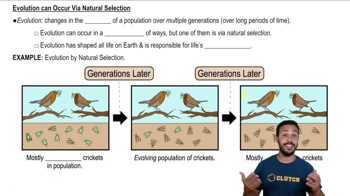
Darwin's phrase describing how species evolve over time from common ancestors, accumulating differences through generations.
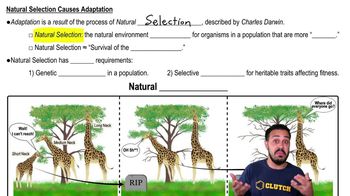
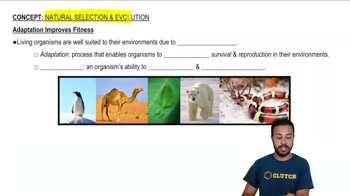
A process where individuals with traits better suited to their environment survive and reproduce more successfully, passing those traits on.
It is supported by extensive evidence, generates testable hypotheses, and explains a broad range of biological phenomena.
Mineralized remains, amber, trace fossils, sedimentary rock fossils, frozen soil/ice, casts, imprints, and coprolites.
An ordered sequence of fossils in rock layers that shows the passage of geological time and evolutionary changes.
Structures inherited from a common ancestor that may have different functions but similar anatomy, indicating evolutionary relationships.
Similar DNA sequences and universal genetic code among species indicate common ancestry and evolutionary relationships.
Remnants of features that had important functions in ancestors but are reduced or nonfunctional in modern species.
All vertebrate embryos have a tail posterior to the anus and pharyngeal pouches that develop into different structures.
A diagram that illustrates hypotheses about the patterns of evolutionary descent among species based on homologous traits.
1) Variation among individuals, 2) Heritability of traits from parent to offspring.
Malthus's idea that populations grow faster than resources led Darwin to realize a struggle for existence drives natural selection.
1) Individuals vary in traits, 2) Species produce more offspring than the environment can support.
1) Individuals with favorable traits produce more offspring, 2) Favorable traits accumulate in populations over generations.
Natural selection acts on individuals, but evolution occurs as populations change over generations.
No, acquired traits during an organism's lifetime are not passed to offspring through DNA.
No, it does not produce perfectly adapted organisms; traits favorable in one environment may be harmful in another.
The scientific study of interactions between organisms and their environment, including abiotic factors like temperature and water.