 뒤로
General Biology Exam 1 Review
 09:50

이 집합의 용어 (31)
The three domains are Bacteria, Archaea, and Eukarya, classifying all living organisms based on cell type and genetics.
Organelles include the nucleus (stores DNA), mitochondria (ATP production), ribosomes (protein synthesis), Golgi apparatus (modifies and packages proteins), and endoplasmic reticulum (protein and lipid synthesis).
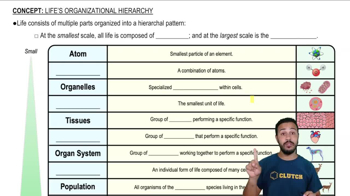
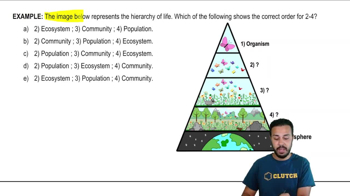
Levels include cells, tissues, organs, organ systems, organisms, populations, communities, ecosystems, and biosphere.
Smaller cells have a higher surface area-to-volume ratio, allowing more efficient exchange of materials across the membrane.
Light microscopy for viewing live cells, electron microscopy for detailed ultrastructure, and fluorescence microscopy for specific molecules.
Oxygen, carbon, hydrogen, and nitrogen are the most abundant elements in the human body.
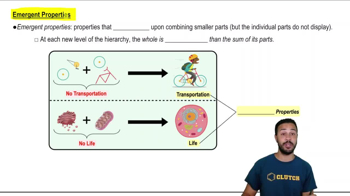
Reductionism breaks complex biological systems into simpler parts to better understand their functions.
DNA stores genetic information that directs cell function and heredity.
Ionic bonds transfer electrons, covalent bonds share electrons, and hydrogen bonds are weak attractions between polar molecules.
Polarity depends on unequal sharing of electrons and molecular shape; polar molecules have partial charges, nonpolar do not.
Oppositely charged ions attract each other, forming ionic bonds.
Acidic substances have pH < 7; basic substances have pH > 7; neutral is pH 7.
Observation, question, hypothesis, experiment, data analysis, conclusion, and communication.
Homeostasis is the maintenance of a stable internal environment despite external changes.
An element is a pure substance of one type of atom; a molecule is two or more atoms chemically bonded.
Both have atoms and molecules, but only living things show metabolism, growth, reproduction, and response to stimuli.
Used for tracing molecules in biological systems and medical imaging.
Atoms gain or lose electrons to become ions with positive or negative charges.
Movement of molecules from an area of higher concentration to lower concentration without energy input.
ATP synthase produces most ATP during the electron transport chain in mitochondria.
Small nonpolar molecules and gases pass freely; large or charged molecules require transport proteins.
Movement of molecules against their concentration gradient using energy (ATP).
In an isotonic solution, water moves equally in and out, so cell size remains stable.
Breaks down glucose into pyruvate, producing ATP and NADH in the cytoplasm.
NAD+ and FAD accept electrons from metabolic intermediates to form NADH and FADH2.
Consists mainly of a phospholipid bilayer with embedded proteins, cholesterol, and carbohydrates.
Includes loose, dense, cartilage, bone, and blood connective tissues.
Loose connective tissue under skin, dense in tendons, cartilage in joints, bone in skeleton, blood in vessels.
Smooth muscle controls involuntary contractions in the stomach wall.
Epithelial covers surfaces, connective supports, muscle enables movement, nervous transmits signals.
Includes tight junctions (seal cells), desmosomes (anchor cells), and gap junctions (allow communication).