What is the role of the promoter in DNA transcription?
The promoter is a DNA sequence where RNA polymerase binds to initiate transcription.
What direction does RNA polymerase synthesize RNA?
RNA polymerase synthesizes RNA in the 5' to 3' direction.
What is the difference between the template strand and the coding strand in DNA?
The template strand is used by RNA polymerase to synthesize RNA, while the coding strand has the same sequence as the RNA (except T is replaced by U).
What are the base pairing rules during transcription?
In transcription, A pairs with U and C pairs with G.
What is the function of tRNA in protein synthesis?
tRNA carries amino acids to the ribosome and matches its anticodon with mRNA codons during translation.
What is a codon?
A codon is a sequence of three nucleotides on mRNA that codes for a specific amino acid.
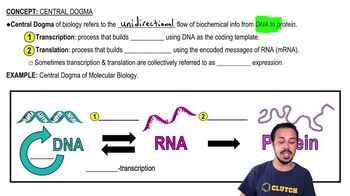
What is the central dogma of molecular biology?
The central dogma describes the flow of genetic information: DNA → RNA → Protein.
What is the role of ribosomes in translation?
Ribosomes facilitate the assembly of amino acids into polypeptides by reading mRNA sequences.
What is the difference between prokaryotic and eukaryotic transcription?
Prokaryotic transcription occurs in the cytoplasm and is coupled with translation; eukaryotic transcription occurs in the nucleus and involves RNA processing.
What is an operon?
An operon is a cluster of genes under control of a single promoter, allowing coordinated gene expression.
What is the function of the lac operon in bacteria?
The lac operon controls the metabolism of lactose by regulating genes needed to digest lactose.
What is the significance of the genetic code being degenerate?
The genetic code is degenerate because multiple codons can code for the same amino acid, providing redundancy.
What is a mutation?
A mutation is a change in the DNA sequence that can affect gene function.
What is the difference between a silent and a missense mutation?
A silent mutation does not change the amino acid sequence; a missense mutation changes one amino acid.
What is the role of RNA splicing in eukaryotes?
RNA splicing removes introns from pre-mRNA to produce mature mRNA for translation.
What are introns and exons?
Introns are non-coding sequences removed during splicing; exons are coding sequences retained in mRNA.
What is the function of the 5' cap and poly-A tail in eukaryotic mRNA?
The 5' cap protects mRNA from degradation and aids in ribosome binding; the poly-A tail enhances stability and export from the nucleus.
What is the wobble hypothesis?
The wobble hypothesis explains how tRNA anticodons can pair with multiple codons due to flexible base pairing at the third codon position.
What is the role of aminoacyl-tRNA synthetase?
It attaches the correct amino acid to its corresponding tRNA, ensuring accurate translation.
What is the difference between transcription factors and RNA polymerase?
Transcription factors help RNA polymerase bind to DNA and initiate transcription; RNA polymerase synthesizes RNA.
 뒤로
 05:45
