 뒤로
General Biology Exam 3 Study Guide
 05:03

이 집합의 용어 (27)
Biofilms are communities of microorganisms attached to surfaces, found in natural, industrial, and hospital environments.
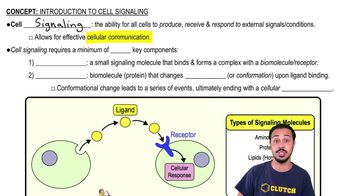
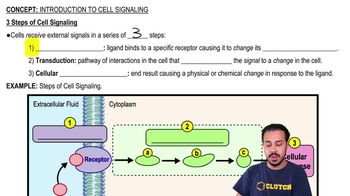
Cell signaling is the process by which cells communicate using signaling molecules and receptors to coordinate activities.
Types include autocrine, paracrine, endocrine, and direct contact signaling.
RTKs are cell surface receptors that phosphorylate tyrosine residues to activate signaling pathways.
DNA is the genetic material; a chromosome is a DNA molecule with proteins; a chromatid is one half of a duplicated chromosome; the centromere is the region where chromatids attach.
The mitotic spindle separates sister chromatids during mitosis to ensure equal chromosome distribution.
A karyotype displays chromosome number and structure to identify abnormalities or sex chromosomes.
Law of Segregation: alleles separate during gamete formation.
Law of Independent Assortment: genes for different traits assort independently.
Genotype is the genetic makeup; phenotype is the observable trait.
A cross between two individuals heterozygous for one gene to study inheritance of a single trait.
A cross between an individual with unknown genotype and a homozygous recessive to determine the unknown genotype.
Inheritance of genes located on sex chromosomes, often showing different patterns in males and females.
A heterozygous phenotype that is intermediate between the two homozygous phenotypes.
Both alleles in a heterozygote are fully expressed, e.g., AB blood type.
One gene influences multiple, seemingly unrelated phenotypic traits.
One gene affects the expression of another gene at a different locus.
The presence of an abnormal number of chromosomes in a cell.
Having more than two complete sets of chromosomes.
Multiple genes contribute to a single phenotypic trait, e.g., skin color.
Somatic cells are body cells with diploid chromosome number; gametes are sex cells with haploid number.
To detect genetic disorders or chromosomal abnormalities before birth.
Maps showing the relative positions of genes on a chromosome based on recombination frequencies.
Map units = \(\frac{\text{Number of recombinant offspring}}{\text{Total offspring}} \times 100\)
Cell division slows or stops when cells become too crowded.
Apoptosis is programmed cell death important for development and removing damaged cells.
Blood types are determined by the presence of A and B antigens on red blood cells controlled by multiple alleles.
Blood types can exclude or support paternity by comparing parental and child blood group compatibility.