Skip to main content
General Biology
나의 코스
배우기
시험 준비
AI 튜터
학습 가이드
교과서적 해결책
플래시카드
탐험해 보세요
앱을 사용해 보세요
나의 코스
배우기
시험 준비
AI 튜터
학습 가이드
교과서적 해결책
플래시카드
탐험해 보세요
앱을 사용해 보세요
뒤로
General Biology Exam II Review
카드를 뒤집기 위해 탭할 수 있습니다.
Define kinetic and potential energy with examples.
카드를 뒤집기 위해 탭할 수 있습니다.
👆
Define kinetic and potential energy with examples.
Kinetic energy
is energy of motion (e.g., moving molecules).
Potential energy
is stored energy (e.g., chemical bonds in glucose).
진행 상황 추적
컨트롤 버튼이 '내비게이션' 모드로 변경되었습니다.
1/23
추천 영상
04:21
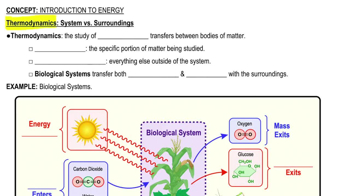
Thermodynamics: System vs. Surroundings
23876
views
387
rank
04:58
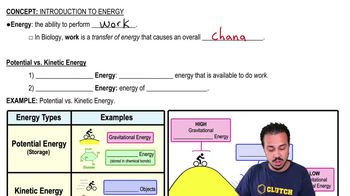
Introduction to Energy
31812
views
636
rank
2
comments
이 집합의 용어 (23)
하이드의 정의
Define kinetic and potential energy with examples.
Kinetic energy
is energy of motion (e.g., moving molecules).
Potential energy
is stored energy (e.g., chemical bonds in glucose).
What is the 1st law of thermodynamics and its relevance to living organisms?
Energy cannot be created or destroyed, only transformed. Living organisms convert energy from one form to another but total energy remains constant.
What is the 2nd law of thermodynamics and its relevance to living organisms?
Entropy (disorder) increases in the universe. Organisms maintain order locally by increasing entropy elsewhere, requiring energy input.
What is an enzyme and how does it function in cells?
An
enzyme
is a protein that catalyzes biochemical reactions by lowering activation energy, speeding up reactions without being consumed.
What factors affect enzyme function?
Temperature, pH, substrate concentration, and inhibitors affect enzyme activity by altering enzyme shape or availability.
Compare competitive and non-competitive enzyme inhibition.
Competitive inhibitors
bind the active site, blocking substrate.
Non-competitive inhibitors
bind elsewhere, changing enzyme shape and function.
Name coenzymes used in photosynthesis and respiration and their role.
NADP+ in photosynthesis and NAD+/FAD in respiration transfer electrons and energy between molecules.
Write the overall equation for photosynthesis.
6 CO
2
+ 6 H
2
O + light energy → C
6
H
12
O
6
+ 6 O
2
Write the overall equation for cellular respiration.
C
6
H
12
O
6
+ 6 O
2
→ 6 CO
2
+ 6 H
2
O + ATP energy
What is the purpose of the light reactions in photosynthesis?
Light reactions convert light energy into chemical energy (ATP and NADPH) and produce oxygen by splitting water.
Name key components of the light reactions in the thylakoid membrane.
Photosystem II (PS II), Electron Transport Chain (ETC), Photosystem I (PS I), ATP synthase, and the H+ gradient.
What is the purpose of the Calvin Cycle (light-independent reactions)?
The Calvin Cycle uses ATP and NADPH to fix CO
2
into glucose and other carbohydrates.
Which wavelengths of light are absorbed by chlorophyll pigments?
Chlorophyll absorbs mainly blue (~450 nm) and red (~680 nm) wavelengths of light.
Define phosphorylation and give an example in cells.
Phosphorylation
is adding a phosphate group to a molecule, e.g., ATP synthesis during cellular respiration.
Define oxidation-reduction (redox) reactions and give an example.
Redox reactions involve electron transfer; e.g., NAD+ is reduced to NADH during respiration.
What are the main sources of atmospheric CO2?
Respiration, decomposition, volcanic activity, and human activities like burning fossil fuels.
What is the function of the electron transport chain (ETC) in photosynthesis and respiration?
ETC transfers electrons to create a proton gradient used to produce ATP.
Name the phases of the cell cycle and their main events.
G1 (growth), S (DNA replication), G2 (preparation), M (mitosis and cytokinesis).
Identify the phases of mitosis.
Prophase, Metaphase, Anaphase, Telophase.
Describe the characteristics of the human genome.
Humans have 46 chromosomes (23 pairs), diploid cells, chromosomes are linear and packaged into chromatin.
How is DNA packaged in the cell?
DNA wraps around histones forming nucleosomes; euchromatin is loosely packed and active, heterochromatin is tightly packed and inactive.
What effects do independent assortment and crossing over have during meiosis?
They increase genetic variability by shuffling alleles and exchanging chromosome segments.
Compare mitosis and meiosis.
Mitosis produces two identical diploid cells for growth; meiosis produces four genetically diverse haploid gametes.
 뒤로뒤로
 04:21