 뒤로
General Biology Exam II Study Guide
 02:21

이 집합의 용어 (35)
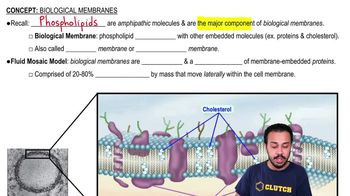
The plasma membrane is composed of phospholipids, proteins, and cholesterol. Phospholipids form a bilayer, proteins assist in transport and signaling, and cholesterol modulates membrane fluidity.
Cholesterol stabilizes membrane fluidity by preventing tight packing of phospholipids at low temperatures and restraining movement at high temperatures. Protein content varies between cells affecting membrane function.
A hypotonic solution has a lower solute concentration than the cell, causing water to move into the cell by osmosis.
A hypertonic solution has a higher solute concentration than the cell, causing water to move out of the cell by osmosis.
An isotonic solution has equal solute concentration to the cell, resulting in no net water movement across the membrane.
Water moves from a hypotonic to a hypertonic solution until equilibrium is reached.
Small nonpolar molecules like O2 and CO2 diffuse easily across the hydrophobic membrane without assistance.
Polar molecules and ions require transport proteins to cross the hydrophobic membrane interior.
The electrochemical gradient combines chemical (concentration) and electrical (charge) forces that drive ion diffusion across membranes.
The Na+/K+ pump uses ATP to move 3 Na+ out and 2 K+ into the cell, creating an electrochemical gradient.
The proton pump actively transports H+ ions across membranes, generating a proton gradient used for energy.
Energy cannot be created or destroyed, only transformed; living systems convert energy from one form to another.
Every energy transfer increases the entropy (disorder) of the universe; living systems maintain order by increasing entropy elsewhere.
A negative change in free energy (\(\Delta G<0\)) indicates a spontaneous, energetically favorable reaction.
Exergonic reactions release energy (\(\Delta G<0\)), while endergonic reactions require energy input (\(\Delta G>0\)).
Enzymes are biological catalysts that lower activation energy and speed up reactions without being consumed.
Enzyme activity is affected by temperature, pH, inhibitors (competitive and non-competitive), and activators.
Competitive inhibitors bind the active site; non-competitive inhibitors bind elsewhere, changing enzyme shape.
Mitochondria have a double membrane with an intermembrane space and a matrix where respiration stages occur.
Glycolysis occurs in the cytoplasm; the Krebs cycle and oxidative phosphorylation occur in the mitochondrial matrix and inner membrane.
Inputs: glucose, NAD+, ADP; Outputs: pyruvate, NADH, ATP.
Inputs: acetyl-CoA, NAD+, FAD, ADP; Outputs: CO2, NADH, FADH2, ATP.
Inputs: NADH, FADH2, O2, ADP; Outputs: ATP, H2O, NAD+, FAD.
Electrons move from glucose to NADH/FADH2, then through the electron transport chain to oxygen, forming water.
Proton gradient created by electron transport drives ATP synthase to produce ATP from ADP and Pi.
Fermentation regenerates NAD+ anaerobically producing less ATP; aerobic respiration uses oxygen for more efficient ATP production.
Alcohol fermentation produces ethanol, CO2, and regenerates NAD+.
Lactic acid fermentation produces lactate and regenerates NAD+.
Autotrophs produce their own food via photosynthesis; heterotrophs consume organic molecules for energy.
Chloroplasts have a double membrane, thylakoid membranes stacked into grana, and stroma where the Calvin cycle occurs.
Light reactions occur in the thylakoid membranes; the Calvin cycle occurs in the stroma.
Photosystem II captures light to split water and generate a proton gradient; Photosystem I captures light to produce NADPH.
Light reactions produce ATP, NADPH, and O2.
The Calvin cycle produces G3P, which can be used to form glucose.
Electrons flow from water to Photosystem II, then Photosystem I, and finally reduce NADP+ to NADPH.