 뒤로
General Biology: Fundamentals and Biomolecules
 09:26

이 집합의 용어 (20)
Life is a self-sustained chemical system capable of undergoing Darwinian evolution and is based on organic chemistry.
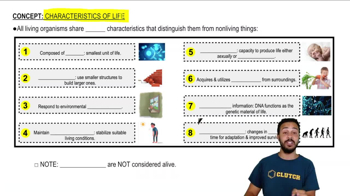
Life is membrane delimited, made of cells, stores and follows instructions, stores and uses energy, is self-replicating, controls functions and responds to the environment, and evolves.
Lipids, carbohydrates, nucleic acids, and proteins support life by providing membranes, energy, information storage, and functional control.
Lipids form selectively permeable membranes, provide compartmentation, act as energy sources, and offer insulation.
Nucleic acids store and transmit genetic information essential for replication and function.
Energy is stored in chemical bonds of molecules and converted into ATP, which cells use to perform work.
Prokaryotes lack a nucleus and membrane-bound organelles, have circular DNA, and are smaller; eukaryotes have a nucleus, linear DNA, and membrane-bound organelles.
The cell is the smallest unit that exhibits all properties of life.
Proteins control cellular functions and enable responses to the environment.
Evolution is the change in heritable characteristics of biological populations over successive generations.
The cell membrane provides a selectively permeable barrier that controls the internal environment of the cell.
Carbohydrates serve as energy sources and structural components in cells.
ATP (adenosine triphosphate) is the primary energy carrier used by cells to perform work.
Mature red blood cells lack DNA, mitochondria, and cannot divide, so they do not replicate but still perform other life functions.
Biomolecules like nucleic acids carry genetic information that enables cells to replicate themselves.
Membranes formed by lipids create compartments that separate cellular processes and maintain homeostasis.
Cells use proteins to detect signals and control functions, enabling responses to environmental changes.
Membrane-bound organelles compartmentalize functions, increasing efficiency and specialization in eukaryotic cells.
Viruses are not fully alive because they lack membranes, do not store energy, and require host cells to replicate, though they evolve and store instructions.
Sunlight provides energy for photosynthesis, which converts it into chemical energy stored in organic compounds used by cells.