Skip to main content
General Biology
나의 코스
배우기
시험 준비
AI 튜터
학습 가이드
교과서적 해결책
플래시카드
탐험해 보세요
앱을 사용해 보세요
나의 코스
배우기
시험 준비
AI 튜터
학습 가이드
교과서적 해결책
플래시카드
탐험해 보세요
앱을 사용해 보세요
뒤로
General Biology: How Populations Evolve
카드를 뒤집기 위해 탭할 수 있습니다.
What is evolution defined as in biology?
카드를 뒤집기 위해 탭할 수 있습니다.
👆
What is evolution defined as in biology?
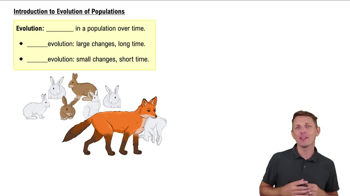
Evolution is the change in
allele frequencies
within a population over time.
진행 상황 추적
컨트롤 버튼이 '내비게이션' 모드로 변경되었습니다.
1/27
추천 영상
03:33
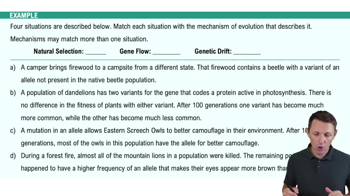
Evolution of Populations Example 1
3793
views
56
rank
05:14
Introduction to Evolution of Populations
4804
views
92
rank
이 집합의 용어 (27)
하이드의 정의
What is evolution defined as in biology?
Evolution is the change in
allele frequencies
within a population over time.
Define a population in biological terms.
A
population
is a group of all members of a specific species living in a defined geographical area and capable of interbreeding.
What is a gene pool?
The
gene pool
is the total sum of all the alleles of all the genes in a specific population.
What does allele frequency represent?
Allele frequency is the
relative proportion
of each specific allele of a gene within the gene pool.
Explain the relationship between genotype, environment, and phenotype.
An organism’s
genotype
interacts with the
environment
to produce the
phenotype
, its observable physical and behavioral traits.
What is the Hardy–Weinberg principle?
A mathematical model of a
non-evolving population
where allele frequencies remain constant if five conditions are met.
List the five conditions required for Hardy–Weinberg equilibrium.
1. No mutations, 2. No gene flow, 3. Large population size, 4. Random mating, 5. No natural selection.
Why is the Hardy–Weinberg equilibrium important?
It serves as a
theoretical baseline
to identify which evolutionary forces are acting on a real population.
What is mutation in evolutionary terms?
Mutation
is the ultimate source of all genetic variability; spontaneous, unrepaired changes in DNA.
Define gene flow.
Gene flow
is the movement of alleles between separate populations, making populations more genetically similar over time.
What is genetic drift?
Genetic drift is the change in allele frequencies due to
random chance events
, especially impactful in small populations.
Describe a population bottleneck.
A
bottleneck
occurs when a natural catastrophe or overhunting drastically reduces population size, causing loss of genetic variability.
What is the founder effect?
When a small number of individuals establish a new isolated population, the gene pool is limited to the founders' alleles.
How does low genetic diversity affect a population?
Low genetic diversity reduces the population's ability to adapt to environmental changes, increasing extinction risk.
Why do influenza vaccines need to be updated annually?
Influenza viruses undergo rapid
mutation
, changing their gene pool and surface proteins each year.
What is natural selection?
Natural selection is a non-random process that filters phenotypic variation, favoring traits that increase reproductive success.
Define fitness in evolutionary biology.
Fitness
is the relative measure of an individual's reproductive success compared to others.
What are adaptations?
Adaptations
are phenotypes that enhance survival and reproduction in a specific environment.
Name two types of agents of selection.
Abiotic factors (climate, soil, water) and biotic factors (competition, predation).
What is coevolution?
A feedback loop where two species act as mutual agents of selection, evolving in response to each other.
Explain sexual selection.
Sexual selection favors traits that increase success in acquiring mates, including dominance and ornamental traits.
What is directional selection?
Selection that shifts traits in one direction, favoring individuals with one extreme phenotype.
What is stabilizing selection?
Selection that acts against extremes and favors the average phenotype, maintaining the status quo.
What is disruptive selection?
Selection that favors both extremes and selects against the average phenotype.
Predict the effect of directional selection on a trait like height.
The population's trait distribution shifts toward the favored extreme, e.g., taller individuals become more common.
Predict the effect of stabilizing selection on a trait like height.
The population's trait distribution narrows, favoring intermediate heights and reducing extremes.
Predict the effect of disruptive selection on a trait like height.
The population's trait distribution becomes bimodal, favoring both very short and very tall individuals.
 뒤로뒤로
 03:33