뒤로

General Biology: Human Systems and Genetics Review

컨트롤 버튼이 '내비게이션' 모드로 변경되었습니다.
1/30
  • Function of the sarcomere

    The sarcomere is the basic contractile unit of muscle fibers responsible for muscle contraction through sliding of actin and myosin filaments.
  • Role of actin and myosin filaments

    Actin and myosin filaments slide past each other within the sarcomere to produce muscle contraction.
  • Cause of action potential in a motor neuron

    An action potential in a motor neuron is caused by the rapid influx and efflux of ions across the neuron's membrane, triggering electrical impulses.
  • Order of events leading to muscle contraction

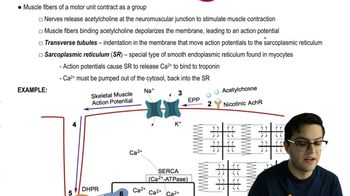
    A nerve impulse triggers an action potential, causing release of calcium ions, which enable actin and myosin interaction, resulting in muscle contraction.
  • Difference between isotonic and isometric contractions

    Isotonic contractions change muscle length producing movement; isometric contractions generate tension without changing muscle length.
  • How most human body heat is generated

    Most body heat is generated by muscle contractions during movement and shivering.
  • Function of intercostal muscles during breathing

    Intercostal muscles contract to expand the rib cage during inhalation and relax during exhalation, aiding lung volume changes.
  • Pressure changes in lungs during inhalation and exhalation

    During inhalation, lung pressure decreases below atmospheric pressure; during exhalation, lung pressure increases above atmospheric pressure.
  • Significance of breathing for humans

    Breathing supplies oxygen for cellular respiration and removes carbon dioxide, essential for energy production and homeostasis.
  • Function of upper respiratory system structures

    Structures like the nose and pharynx filter, warm, and humidify air before it reaches the lungs.
  • Function of lower respiratory system structures

    Structures such as the trachea, bronchi, and alveoli facilitate air passage and gas exchange with blood.
  • Flow of oxygen-rich blood through the heart

    Oxygen-rich blood flows from lungs to left atrium, then left ventricle, and is pumped out through the aorta to the body.
  • Major structures of the human digestive system

    Includes mouth, esophagus, stomach, small intestine, large intestine, rectum, and anus, each aiding digestion and absorption.
  • Role of accessory organs in digestion

    Organs like the liver, pancreas, and gallbladder produce enzymes and substances that aid digestion but food does not pass through them.
  • Function of enzymes during digestion

    Enzymes break down macromolecules into smaller molecules; they are produced mainly in the pancreas and small intestine.
  • Purpose of large surface area in digestion

    A large surface area, especially in the small intestine, increases nutrient absorption efficiency.
  • Difference between standard metabolic rate and basal metabolic rate

    Standard metabolic rate measures energy use under normal conditions; basal metabolic rate measures energy use at rest in a fasting state.
  • Definition of genes and their molecular construction

    Genes are DNA segments that code for proteins; they are made of nucleotide sequences.
  • What are chromosomes and their relation to genes

    Chromosomes are DNA molecules containing many genes; they organize genetic information in cells.
  • Definition of genotype and phenotype

    Genotype is the genetic makeup of an organism; phenotype is the observable traits resulting from genotype and environment.
  • Purpose of a Punnett Square

    A Punnett Square predicts the probability of offspring genotypes based on parental alleles.
  • Difference between dominant and recessive alleles

    Dominant alleles express their trait when present; recessive alleles express only when homozygous.
  • Law of Segregation

    Each individual has two alleles for a trait that segregate during gamete formation, so each gamete carries one allele.
  • Law of Independent Assortment

    Alleles of different genes assort independently during gamete formation, leading to genetic variation.
  • What is incomplete dominance

    Incomplete dominance occurs when heterozygous phenotype is intermediate between two homozygous phenotypes.
  • What is codominance

    Codominance occurs when both alleles in a heterozygote are fully expressed.
  • Definition of polygenic inheritance

    Polygenic inheritance involves multiple genes contributing to a single trait.
  • How environment impacts phenotypic expression

    Environmental factors can influence how genes are expressed, affecting the phenotype.
  • What are linked genes

    Linked genes are located close together on the same chromosome and tend to be inherited together.
  • What is nondisjunction

    Nondisjunction is the failure of chromosomes to separate properly during meiosis, causing abnormal chromosome numbers in gametes.