Skip to main content
General Biology
나의 코스
배우기
시험 준비
AI 튜터
학습 가이드
교과서적 해결책
플래시카드
탐험해 보세요
앱을 사용해 보세요
나의 코스
배우기
시험 준비
AI 튜터
학습 가이드
교과서적 해결책
플래시카드
탐험해 보세요
앱을 사용해 보세요
뒤로
General Biology: Introduction to Metabolism
카드를 뒤집기 위해 탭할 수 있습니다.
Energy
카드를 뒤집기 위해 탭할 수 있습니다.
👆
Energy
Energy
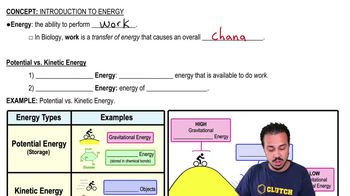
is the ability to perform
work
, which in biology means causing an overall change or transfer of energy.
진행 상황 추적
컨트롤 버튼이 '내비게이션' 모드로 변경되었습니다.
1/26
추천 영상
04:21
Thermodynamics: System vs. Surroundings
23884
views
387
rank
04:58
Introduction to Energy
31824
views
637
rank
2
comments
이 집합의 용어 (26)
하이드의 정의
Energy
Energy
is the ability to perform
work
, which in biology means causing an overall change or transfer of energy.
Potential Energy
Potential energy
is stored energy available to do work, such as chemical energy in bonds.
Kinetic Energy
Kinetic energy
is energy of motion, like moving objects or muscle contractions.
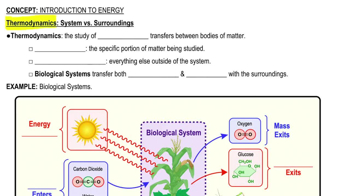
Thermodynamics
The study of
energy transfers
between systems and surroundings, where a
system
is the matter under study and
surroundings
is everything else.
First Law of Thermodynamics
Energy cannot be created or destroyed, only transferred or transformed; total energy in the universe is constant.
Entropy
A measure of disorder or randomness; higher disorder means higher
entropy
. Natural reactions tend to increase universal entropy.
Second Law of Thermodynamics
Energy transfer is never 100% efficient; some energy is lost as heat, increasing the entropy of the universe.
Chemical Reaction
Process involving the making and breaking of chemical bonds, converting reactants into products.
Endergonic Reaction
A reaction that requires an input of energy to proceed (energy enters the reaction).
Exergonic Reaction
A reaction that releases energy as it proceeds (energy exits the reaction).
ATP (Adenosine Triphosphate)
A high-energy molecule composed of adenine, ribose sugar, and three phosphate groups; powers cellular activities.
ATP Hydrolysis
The process of breaking bonds between phosphate groups in ATP, releasing energy and producing ADP.
Energy Coupling
Using energy released from an exergonic reaction (like ATP hydrolysis) to drive an endergonic reaction.
Phosphorylation
The transfer of a phosphate group from ATP to another molecule, often activating or changing the target molecule.
Enzyme
A molecule that catalyzes chemical reactions by lowering activation energy without being consumed.
Substrate
The reactant molecule that binds to an enzyme's active site for catalysis.
Activation Energy (EA)
The minimum energy required to start a chemical reaction by reaching the transition state.
How Enzymes Work
Enzymes lower the activation energy barrier, allowing reactions to proceed faster and at lower temperatures.
Enzyme-Substrate Complex
The temporary complex formed when a substrate binds to an enzyme's active site.
Competitive Inhibition
An inhibitor competes with the substrate for binding at the enzyme's active site, blocking substrate binding.
Noncompetitive Inhibition
An inhibitor binds to an allosteric site, changing enzyme shape and reducing activity without blocking the active site.
Metabolism
The total of an organism's chemical reactions, including metabolic pathways that alter substrates stepwise.
Catabolic Pathways
Metabolic pathways that release energy by breaking down complex molecules into smaller ones.
Anabolic Pathways
Metabolic pathways that consume energy to build larger molecules from smaller ones.
Negative Feedback
When the final product of a metabolic pathway inhibits an earlier step to regulate the pathway.
Positive Feedback
When the final product of a metabolic pathway stimulates an earlier step, enhancing the pathway's activity.
 뒤로뒤로
 04:21