Skip to main content
General Biology
나의 코스
배우기
시험 준비
AI 튜터
학습 가이드
교과서적 해결책
플래시카드
탐험해 보세요
앱을 사용해 보세요
나의 코스
배우기
시험 준비
AI 튜터
학습 가이드
교과서적 해결책
플래시카드
탐험해 보세요
앱을 사용해 보세요
뒤로
General Biology Key Concepts
카드를 뒤집기 위해 탭할 수 있습니다.
What is the smallest unit of life?
카드를 뒤집기 위해 탭할 수 있습니다.
👆
What is the smallest unit of life?
The
cell
is the smallest unit of organization that can perform all activities required for life.
진행 상황 추적
컨트롤 버튼이 '내비게이션' 모드로 변경되었습니다.
1/55
추천 영상
09:50
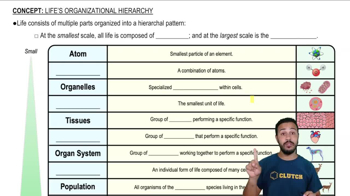
Life's Organizational Hierarchy
28730
views
678
rank
10
comments
04:05
Emergent Properties
18707
views
451
rank
1
comments
03:05
Life's Organizational Hierarchy Example 1
16744
views
464
rank
1
comments
이 집합의 용어 (55)
하이드의 정의
What is the smallest unit of life?
The
cell
is the smallest unit of organization that can perform all activities required for life.
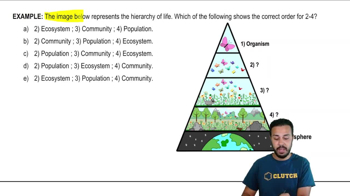
Sequence of biological organization levels
The correct sequence in order of increasing complexity is
cell → tissue → organ → population → community
.
Definition of a population in biology
A
population
is an interacting group of individuals of a single species occupying a defined area.
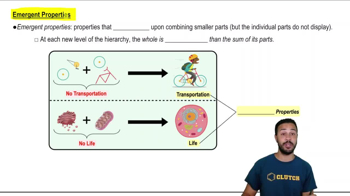
What does the concept of emergence mean in biology?
Emergence means the whole is greater than the sum of its parts; new properties appear as lower-level biological parts combine.
What is reductionism in biological study?
Reductionism is an approach to study complex biological systems by breaking them into simpler components.
What is DNA and its role?
DNA
is the genetic material organized into chromosomes, accounting for both unity and diversity of life.
How do all living organisms show unity in genetics?
All living organisms use the exact same chemical language,
DNA
, to store their genetic code.
What causes diversity among living organisms genetically?
Diversity arises from the specific order of nucleotides in DNA varying from species to species.
What are genes?
Genes
are the fundamental units of inheritance passed from parents to offspring.
What is gene expression?
Gene expression is the process directing the manufacture of a cellular product from the information stored in a gene.
Sequence of protein synthesis from gene to functional protein
The sequence is
transcription → translation → protein folding
.
What is evolution in biology?
Evolution is the core theme and fundamental organizing principle of biology, involving adaptation and change over time.
Explain 'descent with modification'
It means shared traits among organisms indicate common ancestry, while differing traits show adaptation via natural selection.
At what level does natural selection act?
Natural selection acts on the
population
level, not on individual organisms.
Name the three major domains of life
The three domains are
Bacteria, Archaea, and Eukarya
.
What is the ultimate energy source for most organisms?
The
sun
is the ultimate energy source used by most organisms for metabolism and growth.
What is feedback regulation in organisms?
Feedback regulation is an organism's ability to self-regulate using negative feedback to shut down pathways and positive feedback to speed them up.
What are the requirements for a scientific hypothesis?
A hypothesis must be
testable
and
falsifiable
.
What is the core activity of the scientific method?
The core activity is
forming and testing hypotheses
.
What is the role of a control group in experiments?
A control group acts as an unchanged baseline to compare against experimental changes.
What is inductive reasoning?
Inductive reasoning moves from specific observations to a broader general conclusion.
What is a scientific theory?
A scientific theory is a well-supported, widely accepted concept with broad explanatory power backed by large evidence.
What are isotopes?
Isotopes are atoms of the same element with the same number of protons but different numbers of neutrons, causing different atomic masses.
What defines an unstable (radioactive) isotope?
An unstable isotope has a nucleus that decays spontaneously, releasing radiation and transforming into a different element.
What determines an element's chemical reactivity?
Chemical reactivity depends mostly on the number of unpaired electrons in the outermost (valence) shell.
What is a covalent bond?
A covalent bond forms when neutral atoms share a pair of valence electrons.
Difference between nonpolar and polar covalent bonds
Nonpolar bonds share electrons equally; polar bonds share electrons unequally due to differences in electronegativity.
What is an ion?
An ion is an atom with unequal numbers of protons and electrons due to gaining or losing electrons.
What are hydrogen bonds?
Hydrogen bonds are weak bonds where a hydrogen atom covalently bonded to an electronegative atom is attracted to another electronegative atom.
Why is water a polar molecule?
Water is polar because oxygen and hydrogen share electrons unequally, creating partial positive and negative charges.
What causes water's high specific heat?
Water's high specific heat is due to hydrogen bonds absorbing heat when breaking and releasing heat when forming.
What is the pH scale?
The pH scale is logarithmic; each unit represents a 10-fold change in hydrogen ion concentration.
What are buffers?
Buffers are substances that minimize changes in hydrogen and hydroxide ion concentrations to maintain pH stability.
What is organic chemistry defined by?
Organic chemistry is the study of carbon-containing compounds, where carbon is usually bonded to hydrogen.
What is the tetravalence of carbon?
Carbon has 4 valence electrons and can form 4 covalent bonds to complete its valence shell.
What are hydrocarbons?
Hydrocarbons are organic molecules consisting only of carbon and hydrogen; they are hydrophobic and energy-rich.
What are isomers?
Isomers are compounds with the same molecular formula but different structural arrangements.
What are the six essential elements of life (CHONPS)?
Carbon, Hydrogen, Oxygen, Nitrogen, Phosphorus, and Sulfur.
What is the role of the carboxyl group?
The carboxyl group (−COOH) acts as an acid by donating a proton (H+).
What is the role of the amino group?
The amino group (−NH2) acts as a base by accepting a proton (H+).
What is the function of sulfhydryl groups?
Sulfhydryl groups (−SH) help stabilize protein structure through disulfide bridges.
What is the function of phosphate groups?
Phosphate groups (−PO4) store energy in molecules like ATP by releasing energy when a phosphate is removed.
What are macromolecules of life?
Macromolecules include carbohydrates, lipids, proteins, and nucleic acids.
What is dehydration synthesis?
Dehydration synthesis joins monomers into polymers by removing water.
What is hydrolysis?
Hydrolysis breaks down polymers into monomers by adding water.
What is the general formula of sugars?
Sugars have a 1:2:1 ratio of carbon, hydrogen, and oxygen (C:H:O).
Examples of disaccharides
Sucrose, lactose, and maltose are common disaccharides.
Examples of polysaccharides and their functions
Glycogen stores energy in animals; cellulose provides plant cell wall structure; chitin forms insect exoskeletons.
Difference between saturated and unsaturated fats
Saturated fats have no double bonds and are solid at room temperature; unsaturated fats have cis double bonds and are liquid.
What are steroids?
Steroids are lipids with four fused rings, e.g., cholesterol and sex hormones.
Levels of protein structure
Primary: amino acid sequence; Secondary: α-helix and β-pleated sheets; Tertiary: 3D shape from side-chain interactions.
What are chaperonins?
Chaperonins are proteins that assist in proper folding of other proteins.
Components of nucleotides
A nucleotide consists of a nitrogenous base, a pentose sugar, and a phosphate group.
Purines vs. pyrimidines
Purines: adenine (A) and guanine (G); pyrimidines: cytosine (C), thymine (T), and uracil (U).
DNA structure
DNA is a double helix with two antiparallel strands.
 뒤로뒤로
 09:50