뒤로

General Biology: Key Concepts and Foundations

컨트롤 버튼이 '내비게이션' 모드로 변경되었습니다.
1/20
  • What is biodiversity?

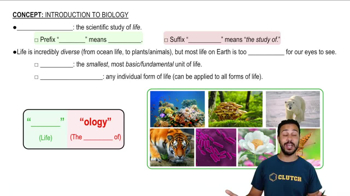
    Biodiversity is the variety of life on Earth at all levels, including genetic, species, habitat, and landscape diversity, along with the ecological and evolutionary processes that sustain it.
  • Name the four types of biodiversity.

    • Genetic Diversity: Variation of genes within species.
    • Species Diversity: Variety of species within a habitat or region.
    • Habitat Diversity: Range of different habitats in an area.
    • Landscape Diversity: Diversity of ecosystems and landscapes across a region.
  • What does the Tree of Life represent?

    The Tree of Life is a model depicting evolutionary history and relationships among all organisms, showing a single ancestral species at its base and three major groups: Bacteria, Archaea, and Eukarya.
  • What are the three foundational theories in biology?

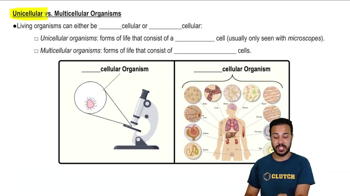
    • Cell Theory: All organisms are made of cells; cells come from preexisting cells.
    • Theory of Evolution by Natural Selection: Explains relationships and population changes over time.
    • Chromosome Theory of Inheritance: Hereditary information is transmitted via chromosomes.
  • List the five fundamental characteristics of living organisms.

    • Cells: Composed of membrane-bound cells.
    • Replication: Capable of reproduction.
    • Information: Process hereditary and environmental information.
    • Energy: Acquire and use energy to stay alive.
    • Evolution: Populations evolve over time.
  • What is the difference between biogenesis and spontaneous generation?

    Biogenesis states life arises only from preexisting life, while spontaneous generation claims life arises from nonliving matter. Pasteur's experiments supported biogenesis.
  • Compare prokaryotic and eukaryotic cells.

    Prokaryotic cells lack a nucleus (Bacteria and Archaea), while eukaryotic cells have a nucleus (Eukarya).
  • What is the chromosome theory of inheritance?

    Hereditary information is encoded in genes on chromosomes; DNA is the hereditary material, and genes code for proteins that determine traits.
  • Describe the structure of DNA.

    DNA is a double helix made of nucleotides, each with a phosphate group, deoxyribose sugar, and nitrogenous base (A, T, C, G). Base pairing occurs as A with T and C with G via hydrogen bonds.
  • What is the central dogma of molecular biology?

    Genetic information flows from DNA to RNA (transcription), then from RNA to protein (translation), with proteins determining cellular functions and traits.
  • Why do living organisms require energy?

    Organisms need energy to survive, acquiring chemical energy as ATP and molecules used as building blocks for macromolecules.
  • What drives evolution by natural selection?

    Evolution requires heritable variation and traits that confer reproductive advantage; natural selection acts on individuals, but populations evolve over time.
  • What is speciation?

    Speciation is the process where populations diverge and form new species.
  • Name the three domains of life.

    The three domains are Bacteria, Archaea (both prokaryotes), and Eukarya (eukaryotes).
  • What is taxonomy?

    Taxonomy is the practice of naming and classifying organisms into hierarchical ranks: domain, phylum, class, order, family, genus, and species.
  • How is a scientific name formatted?

    A scientific name has two parts: Genus (capitalized and italicized) and species (lowercase and italicized), e.g., Homo sapiens.
  • What is the goal of the scientific method?

    To develop testable and falsifiable hypotheses and create highly probable explanations for natural phenomena through observation and experimentation.
  • Describe the food competition hypothesis for giraffe neck length.

    It proposes giraffes evolved long necks to reach food unavailable to other mammals.
  • Describe the sexual competition hypothesis for giraffe neck length.

    It suggests long necks evolved because males with longer necks win more fights and father more offspring.
  • What did data about giraffe neck length support?

    Data support the sexual competition hypothesis, but scientific questions remain open for further testing.