 뒤로
General Biology: Key Concepts and Foundations
 09:50

이 집합의 용어 (26)
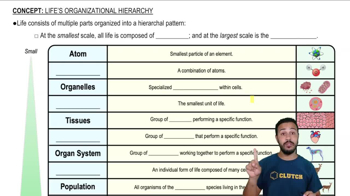
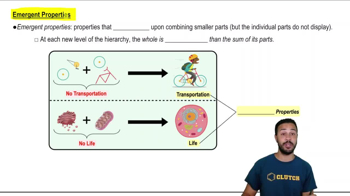
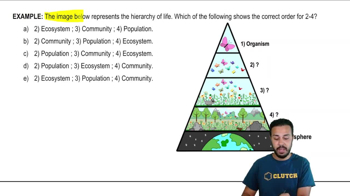
Organized from simplest to most complex: molecules, cells, tissues, organs, organ systems, organisms, populations, communities, ecosystems, and biosphere.
Growth, reproduction, response to stimuli, metabolism, homeostasis, cellular organization, and evolutionary adaptation.
Bacteria, Archaea, and Eukarya differ in cell structure and genetics.
Natural selection is the process where organisms with favorable traits survive and reproduce, leading to evolutionary change over generations.
Includes observation, question, hypothesis, experiment, data analysis, and conclusion.
A hypothesis is a testable prediction; a theory is a well-supported explanation based on extensive evidence.
Used to determine if data results are due to chance or represent a real effect, often using p-values to assess significance.
Science seeks to understand natural phenomena; technology applies scientific knowledge for practical purposes.
Biodiversity supports ecosystem stability, resilience, and provides resources for medicine, food, and ecosystem services.
Extinction reduces species variety, disrupting ecosystems and decreasing genetic resources.
Climate change alters habitats and species distributions; emerging diseases threaten health and biodiversity.
Both ecosystems support high biodiversity and provide critical ecosystem services like carbon storage and habitat.
Atoms consist of protons (positive charge), neutrons (neutral), and electrons (negative charge).
Atomic number = number of protons; mass number = protons + neutrons.
Isotopes differ in neutron number, affecting atomic mass and stability.
Electrons occupy shells around the nucleus; outer shells have higher energy and determine chemical behavior.
Radioactive isotopes emit radiation; low levels can be used medically, high levels can damage cells and DNA.
Atoms bond chemically to form molecules and compounds, which have distinct properties.
Ionic, covalent, and hydrogen bonds differ in strength and electron sharing or transfer.
Covalent bonds are strongest, ionic bonds are intermediate, and hydrogen bonds are weakest.
Water forms hydrogen bonds, making it an excellent solvent for polar and charged molecules.
Water's cohesion, temperature regulation, and solvent abilities support biological processes.
Water's solid state is less dense than liquid, allowing ice to float and protect aquatic life.
Acids release H+ ions; bases release OH- ions in solution.
pH = -log[H+]; pH below 7 is acidic, above 7 is basic.
Buffers absorb excess H+ or OH- ions to maintain stable pH in biological systems.